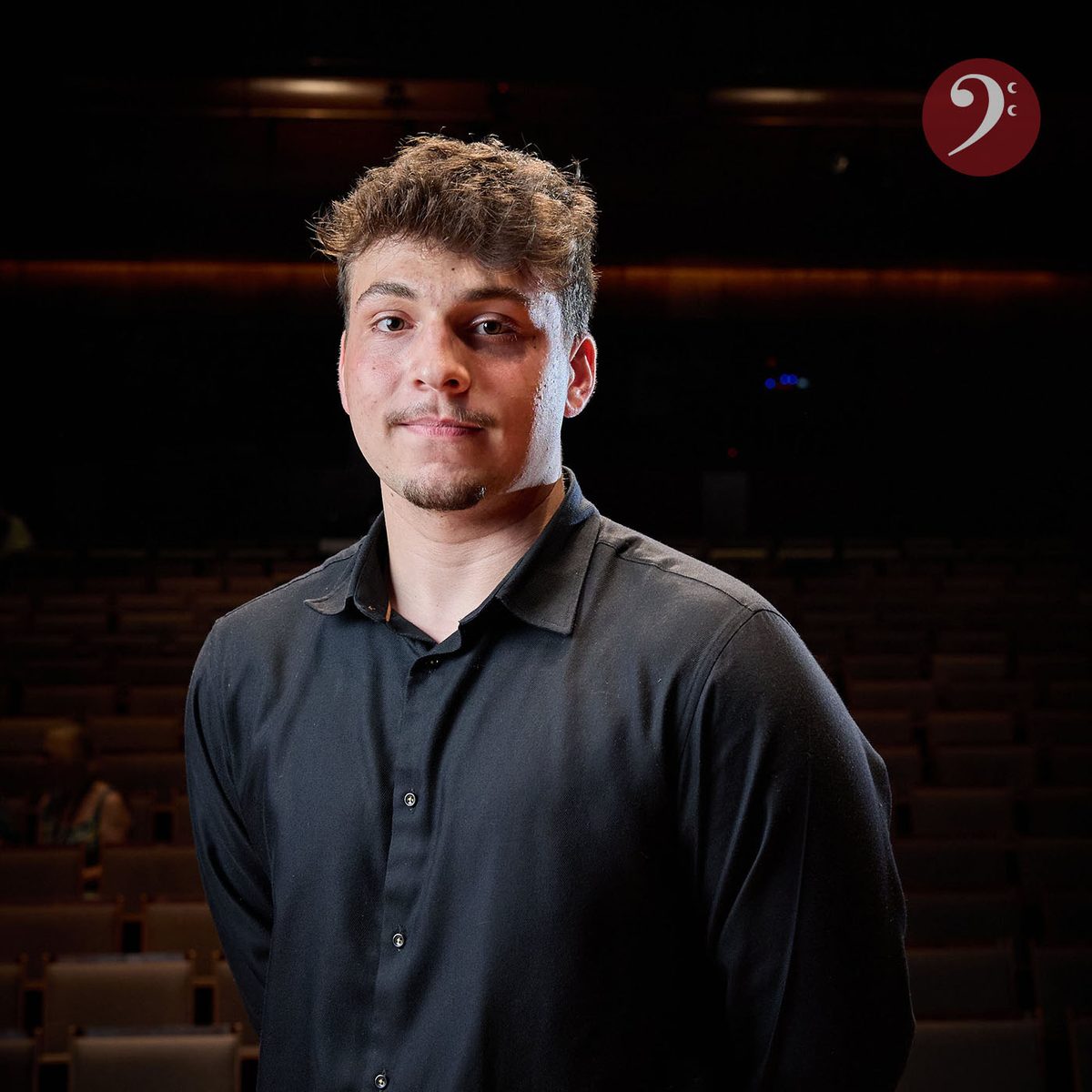
At just 18, London-based double bassist Eduard Marcu became the first bassist to win Junior Guildhall’s prestigious Lutine Prize. Born in Romania and raised in London, Eduard began playing bass at age 10, developed his craft at Junior Guildhall, and performed with the National Youth Orchestra of Great Britain before beginning his studies at the Royal Academy of Music.
Eduard joins Jason to talk about preparing for an all-instrument competition, balancing projection with a singing sound, and learning from musicians beyond the bass world. They also explore his approach to bow hair and weight, the influence of violinist Augustin Hadelich and bassist Ovidiu Bădilă, adapting violin and cello repertoire, navigating London with a bass, and his ambitions across orchestral, chamber, and solo playing. Enjoy, and be sure to give Eduard a follow on Instagram!
This interview has been edited for clarity.
Getting Started on the Bass
Jason: How’d you get into bass? Did you start on bass, or what was your first musical instrument?
Eduard: I started on the double bass when I was around 10 or 11 years old. Double bass was my first instrument. I remember we could choose between the violin, cello, or double bass. My teacher told me that well-behaved students played the double bass because I was quiet and shy when I was younger. My teacher convinced me to choose it.
Jason: Were your parents musical? Did either of them play musical instruments, or do you have music in the family?
Eduard: My dad used to play the drums, more like folk music, because of my uncle as well. But otherwise, no, not classical music.
Jason: And did you grow up in Romania, or were you growing up in London at this point?
Eduard: I was born in Romania, but we came to London when I was like two years old. So I basically grew up in London.
Jason: Was it, “This is what I’m gonna do for the rest of my life, I’ve found it,” or was that one of many things you were interested in? How quickly did you become bass-focused?
Eduard: Well, I wasn’t that focused on playing the double bass. It was mainly just a hobby. I never took it that seriously up until I joined the junior music conservatoire at Guildhall School of Music. My first teacher was at my primary school, and she saw my talent and asked if I wanted to audition.
I auditioned for the junior conservatoire, and from then on I took it more seriously. I decided I wanted to make it a proper career. I started enjoying music, not just playing the double bass so I could get rid of it.
Competitions
Jason: When did you start doing competitions? Do you remember what the first one was?
Eduard: It was actually like the second proper competition. The one before was like a week before the Guildhall one — I think it’s called North London Music Festival. That was only for double bassists. I remember I did some Bottesini, and I got first place, but it wasn’t as serious a competition. But it was like my first proper one I ever did, because up until then I didn’t take it that seriously. I just didn’t really put myself out there.
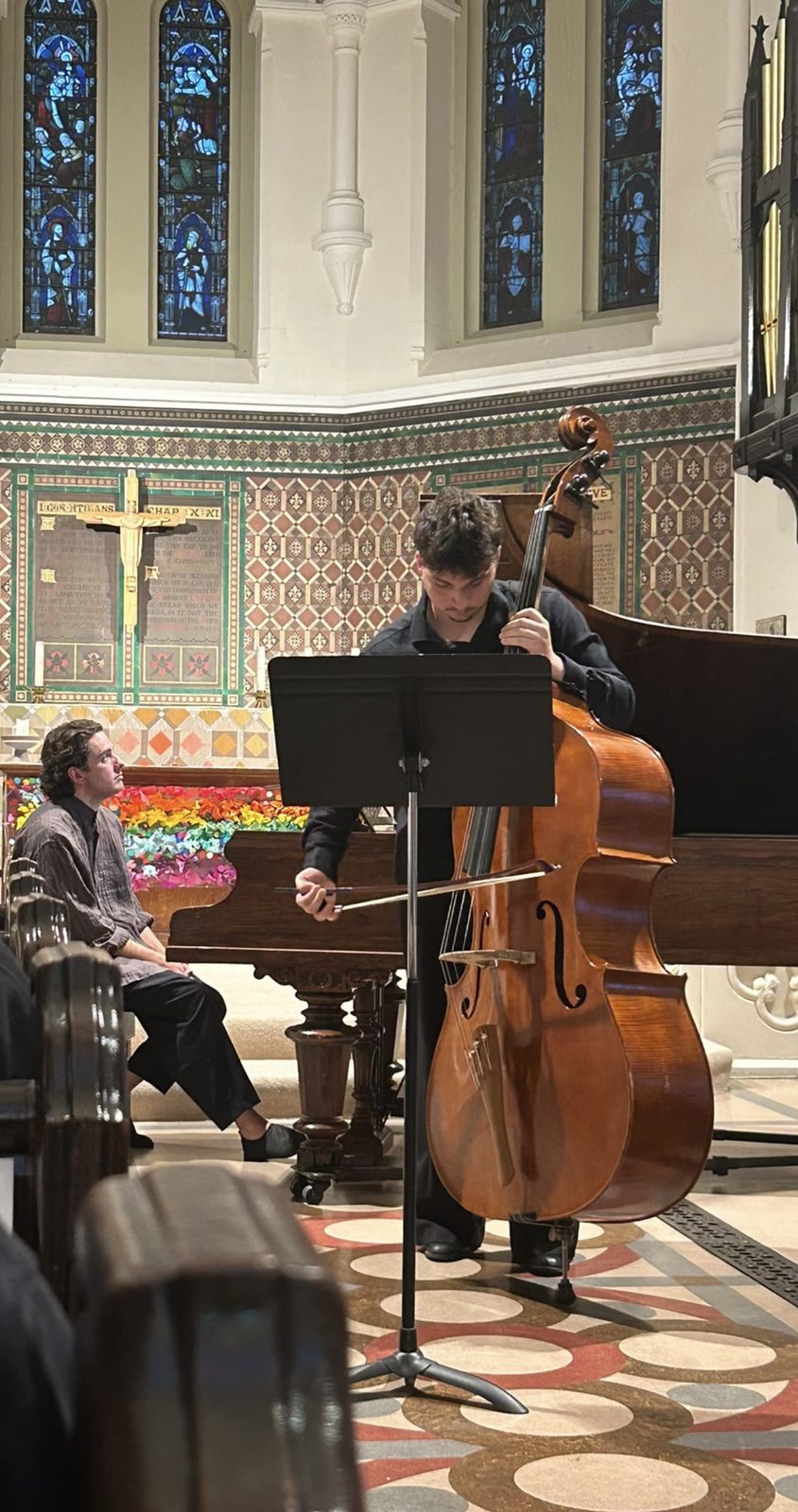
Jason: It’s super exciting to go to a competition like Guildhall, where you are competing against all instrumentalists — not just bass players. That’s such a different universe. We stand out as bass players in some ways, but it’s also a big obstacle for us to express ourselves on this giant instrument. How did the preparation differ for the Guildhall competition?
Eduard: Well, yeah, quite a bit. I started focusing more on sound projection, because compared to an instrument like the violin, the horn, or the cello, the bass doesn’t project as much, especially in solo playing. I also started playing more musically—not just playing the notes, but giving the double bass more of a singing quality. Basically playing the double bass like it’s a violin.
Developing a Vocal, Singing Sound
Jason: That’s one of those things that sounds easier to do than it actually is. “I want to be more vocal” — that’s been my goal for 30 years, yet I’m still working on it! How did you hold yourself accountable? Did you play for other people, record yourself, or make it a daily priority?
Eduard: Playing in front of other people helped a lot, because they can give you immediate feedback.
I remember when I was playing at my junior music school, I played for a cellist. Cellists are obviously a lot more expressive, and he told me to try to add more of a singing quality through vibrato. Playing in front of other people helped a lot.
Jason: And it sounds like playing for people that aren’t just bass players. I think we bass players can get so comfortable playing around other bass players, and we’re all just into all these little details. And then you go play for a violinist or a cellist, and they’ll say, “Everything’s out of tune, and you’re not expressive.” We get so obsessed with our instrument that it can feel like staring in the mirror, playing for other bass players.
Eduard: Exactly.
Jason: How much of a concern did projection end up being for you? Did you figure out ways to project more, or were you actually projecting enough and people just wanted you to be more expressive? You think your sound’s so big, and then you walk onto a stage for a competition and it feels like you’re whispering out there.
Eduard: Well, I try to project my sound, but I think it reaches a point where too much projection — forcing it too much — can remove the other singing qualities, especially in solo playing. It was quite different in a proper concert hall than in my room, where it just sounds loud all the time. My pianist has helped as well, because they have to play a lot quieter than they’re used to when accompanying violinists, since the bass is much quieter. It’s quite a challenge.
Sound Approach Across Different Contexts
Jason: You’re learning in the way orchestral players learn, but you’re also doing great as a solo player, and I read you’ve been getting into chamber music too. Do you use the same sound for all of those? How does your approach to projection or tone change between a solo competition and playing in the orchestra at Guildhall?
Eduard: Well, I would say it’s mainly the way I use my right hand — the amount of bow hair.
In orchestral playing, you basically have to use more flat hair so the sound can project a lot more, because you’re playing against so many other instruments. But if you do that in solo playing, it’s not as nice of a sound.
So in solo playing, I usually use less bow hair, but still use more weight in my right hand so the sound can project well and still sound nice.
Influences and Inspiration
Jason: Who are some of your influences? Who really got you going, and who do you listen to these days for inspiration — bass or beyond?
Eduard: I listened a lot to soloists, not only double bass soloists but violinists as well. For the piece I played à la Mendelssohn by Bottesini, I wanted to get into the world of Mendelssohn, so I listened to Augustin Hadelich. I love him as a soloist — his tone, his everything.
But for bassists more specifically, it would be Ovidiu Badila. He was Romanian as well, and he knew some of my old teachers in Romania. From him I really took a lot about the expression you show in music — because in double bass, most soloists don’t really express themselves.
But when I watch him, I feel like he’s almost like an actor, the way he shows everything through his expressions. It’s just such a joy to watch him.
Repertoire Choices and Strategy
Jason: What else did you play for the competition?
Eduard: Adolf Míšek’s Legende. That was a lot more lyrical and expressive than the Bottesini, where there are a lot more notes and I have to focus on technique.
Jason: That’s a great combo — you get the lyricism, but then you get the pyrotechnics from the Bottesini. What else did you maybe think about playing for that competition? What pieces have been top of mind the last year or two?
Eduard: Mainly Bottesini pieces — his Fantasies, La Sonnambula, and his Elegies. I was thinking of doing his first Elegy as my contrasting piece to the à la Mendelssohn, but I didn’t want to do only Bottesini.
I chose the à la Mendelssohn mainly because some of the musicians listening to me were violinists who know the Mendelssohn Concerto, so I thought it would be interesting for them to hear what it sounds like on the double bass — and to show them what can be played on the bass in terms of solo playing, rather than some more unknown Bottesini piece they might not have heard of before.
What’s Next: The Royal Academy of Music
Jason: What’s next year look like for you?
Eduard: So next year I’m going to the Royal Academy of Music Conservatory for the next four years. Guildhall was just on Saturdays—basically Saturday school: music one day a week, with orchestra and theory lessons. But now, because I’ve just finished my A levels, my final exams, I can go to conservatory and focus only on music.
Jason: What do you see yourself doing in five years?
Eduard: I would say probably joining a good orchestra so I can still have that fundamental bass playing. At the same time, I still want to develop my solo playing and chamber music, because I think I would probably get bored of playing orchestral music all the time. I would rather find new possibilities and new pieces that can be played on the bass—not only bass repertoire, but more like cello and violin repertoire, adapted.
Life in London
Jason: What’s it like living in London and studying music there? Do you see yourself in London long term?
Eduard: London is fun because there are so many things to do, so many diverse people and cultures. And there’s music as well — obviously well-known orchestras like the LSO or the Royal Philharmonic. It’s fun to live there, and as a student especially, the people are nice. I can’t wait to see what kinds of musicians I’ll bond with.
Jason: Do bassists take their bass on the Tube? Is that the normal thing in London?
Eduard: Usually I try to force my dad to drive me, so it’s a lot easier! But if not, I’m forced to take the Tube, and it’s a bit of a struggle. It depends — if it’s crowded, it’s quite bad. But you just have to get used to it. With the bass buggy and the wheels, that’s fine.
Jason: I really appreciate you taking some time to chat. You’ve got a lot of career ahead of you, and it’s really exciting!
We discuss topics like this every week in our email newsletter. We also offer free monthly sheet music giveaways, community news, and all sorts of cool opportunities for bass players. If you’re not on the list, consider subscribing!