

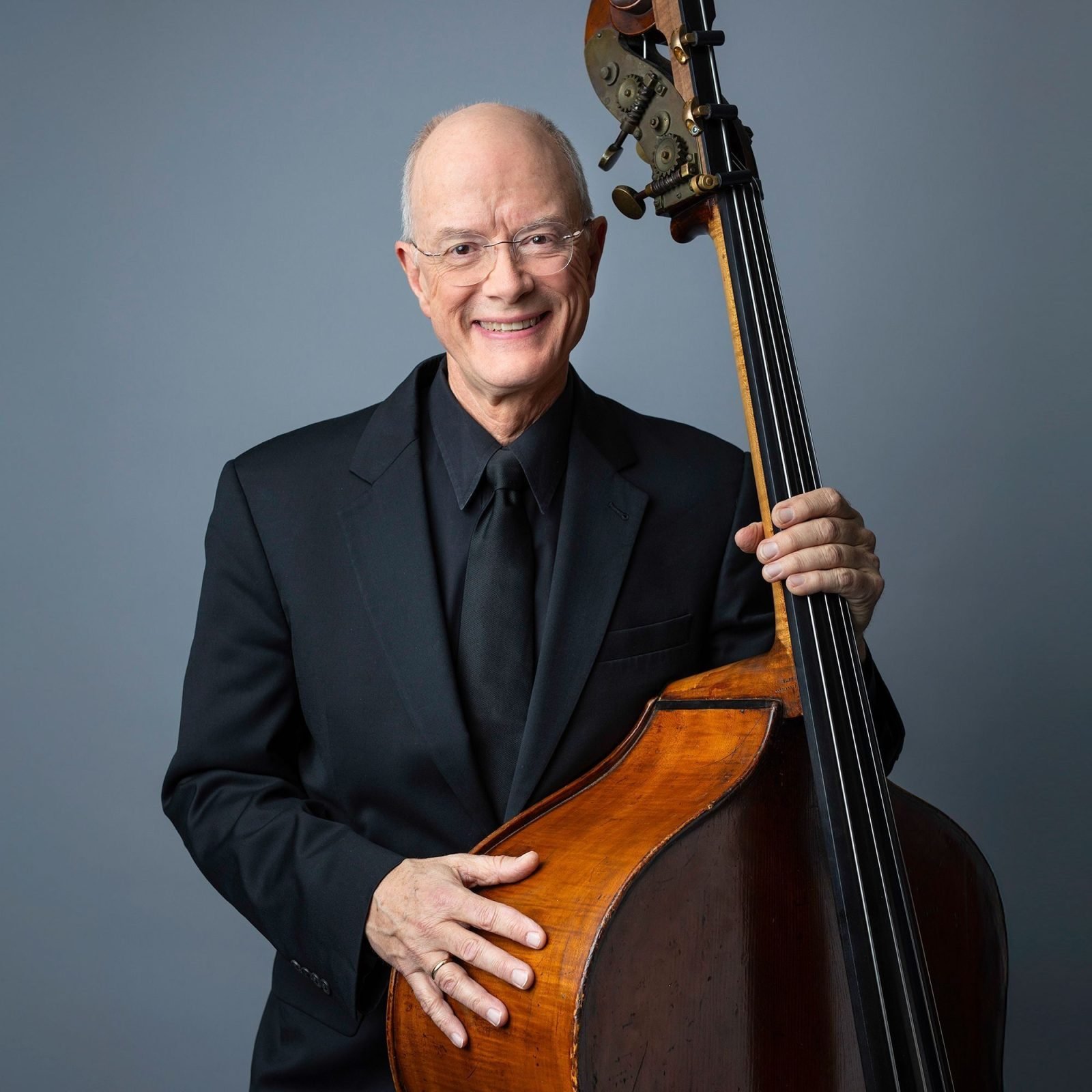
To celebrate the retirement of longtime Boston Symphony Principal Bassist Ed Barker, we’re publishing an excerpt from our Contrabass Conversations podcast interview with him. This interview, conducted in 2009 by podcast co-host John Grillo, has been edited for clarity.
Discovering the Double Bass
John: When did you start playing double bass?
Ed: I started when I was nine years old in the fourth grade. This would be around 1964 or so. I was fortunate in that we were part of a string program at the school I attended in Plattsburgh, New York. I’m from Plattsburgh, New York, a small city located in northern New York, approximately an hour south of Montreal.
It’s on the shores of Lake Champlain. There’s a state university teachers’ college there. That college had an elementary school associated with it. I was enrolled in that school, and they had a fairly progressive string program there. And for me, this was rather fortuitous because it introduced me to the double bass.
Essentially, the whole thing for me was a mistake because I was asked if I wanted to play the bass. I was noticed as being fairly tall for my age and having large hands, and the music teacher at the program asked me if I wanted to play the bass. At the time, I really wanted to play the drums.
I thought he meant bass drum. I had no idea what a string bass was, so I said yes. It turns out that this school had a mandatory string program for all fourth graders, so everyone was required to play an instrument. In my case, I started on the bass and turned out to be rather good at it.
Early Training and Ed’s First Teacher
My parents noticed this, as well as the music teacher at the elementary school program. They connected me with a really fine string teacher who was associated with the state university in Plattsburgh. His name was Angelo Lana, and he essentially was my first teacher.
And he was actually very good in a lot of ways. His style of teaching was, as I recall, somewhat similar to the Suzuki system in that, with very young players, he required that one of the parents come and sit in on the lesson and observe it, and then the parent had to supervise the student’s practicing.
In my case, I had to practice for half an hour every day. I was required to practice for half an hour daily if I wanted to take lessons. What I really wanted to do was go outside and play baseball and all of that. I was told that if I practiced for half an hour a day, I could go out and play.
Of course, that was a strong motivation at that point. But the long story short is, I got pretty good, pretty fast. I showed some talent, and that’s essentially how I got started. I began studying bowing techniques and approaches that were essentially the same as those used by upper string players — violas and violinists.
My teacher’s primary instrument was the viola, although he also taught and played all other string instruments. He would give me bowing exercises that he gave to all the upper string players. So I think from the get-go, I had an immersion in an approach that was oriented from an upper string player’s point of view, which was very, very good for me early on.
He was a very strict teacher — no nonsense and very organized. That’s what a kid needs. And that’s essentially how I got started on the instrument.
Ed meets Fred Zimmerman
John: Then you went to college in Boston, correct?
Ed: A lot actually happened in between. I must give a lot of credit to my teachers.
I think I was very fortunate to have had some excellent teachers along the way. I also had supportive parents, and that’s really important as well. The thing that really lit the fire for me was when I was 11 years old. I went to a music camp in Northern New York — it was a summer camp put on by the Crane School of Music in Potsdam, New York.
The bass teacher at this camp was Frederick Zimmermann. When I went to this place, I met Fred Zimmermann, and there were some other really fine students there as well. I was actually blown away by what I was hearing being done on the double bass. He was also a very great and inspirational speaker and teacher.
At this camp, I was also initially exposed to a lot of chamber music through string quartet performances. I think the Lenox String Quartet was the quartet in residence there. All of these exposures were significant — it was the first time I had experienced that sort of thing with such intensity.
Clearly, the whole concept of string playing — the sonority, texture, the singing quality of string playing, and the blend of string instruments in the quartet and string orchestra setting — really caught hold with me. And that was the moment, that was the time when everything caught fire.
And it turned out that I was pretty good and was getting noticed by teachers, including people like Fred Zimmermann. For a while during my high school years, my family moved to the Los Angeles area in California. When I was there — I was still in junior high school, actually — I studied with Peter Mercurio, who was a well-known teacher on the West Coast. Peter was a very influential teacher for me. He was one of the top studio players in the Los Angeles area, and previous to that, I believe he had played in the Indianapolis Symphony and studied at Eastman. Peter was a fantastic teacher and a very inspiring person, as he was very laid-back and his teaching style was very supportive and friendly.
I spent a year studying with him, and then three summers at the Music Academy of the West in Santa Barbara, where he taught. He was a very great influence. This was all by the time I was about 15 or 16. At that point, we moved back to the East Coast.
Connecting with Henry Portnoy and the Boston Bass School
Then I met and started studying with Henry Portnoy. Henry Portnoy was the principal bass in the Boston Symphony, and I was going to Boston once a month or so to take lessons with him. I met him through an interesting bass teacher who also had a great influence on me, although I never actually technically studied with him. I had met a guy by the name of David Cobb.
I don’t know if that name sounds familiar to you, but Dave is actually the father of Tim Cobb, who’s the principal bassist in the Metropolitan Opera Orchestra
(update: Tim won the principal bass position of the New York Philharmonic after this interview was conducted.)
Dave was a very enthusiastic bass player, and he took an interest in me and my playing. He introduced me to Henry Portnoy, and that’s how I got involved in the Boston scene and the Boston way of playing the bass. I went to New England Conservatory to study with Henry Portnoy after I graduated from high school. I studied with him for four years at New England Conservatory, and of course, his way of teaching was very no-nonsense, very disciplined, and very analytical. His teaching was in-depth, analytical, and amazingly articulate in terms of the way he described processes in performing and playing the instrument.
The thing that was fantastic about his teaching — and I would have to say he was certainly one of the most influential teachers for me — was his way of analyzing things in great detail. Essentially, he would say, “This is what you have to do. This is how you do it, and this is why you do it from a musical point of view.” Very important — one of his best phrases, and I love this phrase, was that essentially his job as a teacher was to do himself out of a job, in that his goal was to teach the student to be able to teach themselves. And really, that is, I guess, the most important thing that a teacher can do with a student. Portnoy was really quite good at that.
The Decision to Finish School
John: After you finished school, one of your first major positions was with the Chicago Symphony before joining the Boston Symphony, is that correct?
Ed: Yes. In the middle of my senior year at New England Conservatory, I auditioned for the Chicago Symphony and got the job. But before that, I was a student at Tanglewood in 1975, between my junior and senior years at the conservatory. During that time, there was an opening in the New York Philharmonic.
I decided to take the audition. It was in the summer, and it was one of the first — I think the first major audition I had ever taken. I wasn’t hired, but no one was hired. They apparently liked my playing enough that they wanted to try me out for a little bit.
And so I decided to go to New York and shorten my senior year at NEC, going to New York to play as a substitute with the New York Philharmonic. It was there that I met John Schaeffer, who was the principal bass there, and Orin O’Brien and Shelly Saxon and the members of the section there.
Orin was very helpful to me. She loaned me one of her instruments to play when I went there. I was there for a few weeks — this would be January of 1976. While I was in New York, there was an opening in Chicago, which I auditioned for and got the job.
So for me, that was a happy experience. I decided that I had all of my life to work, but I did not have all of my life to really study exclusively. So I told the Chicago Symphony that I was happy to start in June. And instead of staying in New York, I decided to go back to New England Conservatory and finish my degree there.
And then when I graduated in June, I went to Chicago. For me, it was a very important four or five months. I really believe that studying is a very unique thing, and in some ways it’s the best part of our lives. I was really glad that I went back to NEC and continued to study and practice really hard.
That preparation and practice helped prepare me for what eventually became the principal audition with the Boston Symphony, which occurred about six or seven months, maybe eight months later. Of course, that happened in the fall of 1976, and that particular outcome for me was a happy one.
And it ended up that within the space of a year and a half or two years, I had played with the New York Philharmonic, the Chicago Symphony, and the Boston Symphony. My experiences in Chicago were wonderful. At that time, Solti was the music director. The bass section was fantastic.
Winning the Boston Symphony Principal Chair
John: You were in your early twenties when you won the principal Boston position, right?
Ed: I was 22.
John: How was that, to be so young and have such a major job? Must have taken some time to get used to that. Did it feel natural?
Ed: Well, being a principal is definitely a lot different than playing in the section.
I always like to say it’s about 20 degrees hotter in that chair than it is in the other chairs in the section.
When I first got the position — of course, I don’t presume to second-guess what other people thought about such a young person getting a job like that. What I do know is that when I was 22, I had already gained some fairly significant professional experience.
Not only as a freelancer, but by the time I came to Boston, I had already played in two major orchestras, principally the Chicago Symphony. During that year and a half that I was there, I played with conductors such as Solti, Giulini, James Levine at Ravinia, Daniel Barenboim, Claudio Abbado, André Previn — a huge list.
So I’d had a lot of fairly significant exposure to some great conductors and also fantastic experiences in that orchestra. And I think watching and learning from Joe Guastafeste was very helpful as well. I thought he was a very strong section leader. And even though his personality and style of playing were a little different than mine.
I still admired a lot of what he did, and I tried to use some of what I learned from playing in that section when I came to Boston, although the Boston section was a very different kind of bass section at that time. But yeah, it’s a lot hotter in the principal chair, and I don’t think people who sit in the section quite appreciate that until they’ve actually had to be in that position and experienced it.
I mean, my first day on the job in Boston, the very first day I showed up for the very first rehearsal, we had to play Mahler’s First Symphony and I had to play the bass solo from that. And by the end of that week, we recorded it — Seiji Ozawa was conducting and we recorded it with Deutsche Grammophon.
And so, yes, it’s a lot hotter in the first chair, believe me!
Bow Stroke Deep-Dive
Part 1: On-The-String Strokes
John: That’s great. I’d like to move things forward here a little bit because I definitely want to spend some time talking about articulation. It’s interesting hearing your background and how you were immersed in that high-level technique. I’ll never forget the lecture you gave us when I was studying with you at Tanglewood, with your symbols and all that. You could start wherever you’d like talking about the importance of the martelé stroke. Maybe we could begin with the on-the-string stroke, then discuss the off-the-string stroke. I remember you taught me a lot of great exercises for staccato and sauté and similar techniques. So perhaps we could start with your approach to both on-the-string and off-the-string techniques.
Ed: Sure. I’m happy to do that. I want to preface this by saying that this detailed discussion of articulations has a lot to do with my schooling. Most of this information I didn’t really make up — I didn’t just sort of pick it out of the air. A lot of it comes from Henry Portnoy’s teaching and schooling.
His analytical approach to learning rubbed off, so I have to give him a lot of credit for these discussions.
I think what I’ve done, of course, is what I think — and I would hope — all good students do: I adopted his approach, adapted it, and made it my own, fit my personality in the way I like to play. And that’s, of course, what all students should do with their schooling.
But it has to be understood that the approach to articulations has to do with the way we approach music and phrasing in general.
The articulations aren’t necessarily an end in themselves, but they are a means to creating and producing sophisticated musical phrasing.
A lot of what we do in music, especially on string instruments — but I think all instruments — is essentially an attempt to emulate the voice, to create a singing concept by way of the instrument. Music needs to be understood as a language, just like any spoken language. And in fact, there are many analogies between music and language, not the least of which is the singing concept.
The articulations are based on an analysis of how to phrase things in a style that is rather similar to the way we would speak. For instance, just as an example, if you read any paragraph — if you speak any paragraph in the English language or any language for that matter — and listen to it, you’ll hear that there are going to be a series of pauses. There’s a lot of breathing. There is movement, there is repose at the end of sentences. There are various articulations, different kinds of consonants, and there are softer articulations, which are more vowel-like. All of these things make language really colorful, interesting, and also understandable.
And that’s the exact parallel in terms of playing the instrument. In my schooling of bass playing, there are many articulations that follow a continuum — from very vowel-like, soft, and connected gestures to very short, staccato, and consonant gestures and sounds. Some of these are played on the string and some are played off. The on-the-string articulations include legato, martellato, portato, some aspects of détaché, and many accented gestures.
The Legato to Détaché Continuum
If you consider the continuum from longest to shortest on the string, in my schooling of playing, the longest and most connected is the legato. Basically, that’s a bow stroke where you draw the bow back and forth (or up and down, up bow and down bow), and the goal is to make a very clean and inaudible bow change. I suppose legato also technically would be a series of notes under a slur.
On the double bass, we have to develop a very good legato bow stroke where we actually have to change bows. So you could have a series of notes under a slur, but because our bows tend to be shorter and our strings longer, it’s often necessary for us to change bow under a legato slur. So it’s very important to have a bow change that is very clean. And the legato bow stroke is the essential way to do it, although it’s much easier said than done.
When changing from a down bow to an up bow (or the other way around), you need to maintain the same speed and pressure that you’re moving at. There seems to be a physical or neurological inclination that everyone has to “kick” the bow change — when we change the bow, we actually speed up the bow, which puts a little kick into the change and disrupts the legato.
So the discipline is learning to draw a bow that feels as if you’re slowing down when you change the bow. What you’re actually doing is negating the kick by having a very slow bow change. This is an important thing to know how to do because, since our strings are so thick, it’s often necessary for us to engage the string very slowly, even from a dead start on the string.
If we don’t engage slowly, then what happens is the string will not speak immediately, and therefore you’ll get what I would refer to as an extraneous noise or a non-musical sound. In other words, you get a scratch. And so the legato bow stroke is really important to learn how to do.
Then we work our way on a continuum from there into a detached, slightly detached bow stroke. I would call this an “on the string détaché.” And this is where we draw the bow, stop the bow, then start the bow again in the next direction. And we do that while engaging the string, again, slightly on the slow side, so that it makes for a clean break between the bow changes, but not having a consonant attack on the bow change. A consonant attack would be anything that creates a pinched sound on the string, like a “c” or a “t” or a “d.”
So, as I said before, the continuum from legato to sustained détaché is still a non-consonant attack concept. Later on, we learned to add consonants to both strokes, and we could talk about that in a minute. As a matter of fact, we’ll talk about it right now.
Marcato
The next idea would be a marcato. In the marcato, the musical sound begins rather abruptly, and there’s a very audible, marked attack. I call it a consonant attack at the beginning of the bow stroke. You could liken that to either a “t” or a “b” pronounced very clearly, like “boy” or “toy” rather than “wall,” for example.
Yes, take the difference between “ball” and “wall” as an example. With marcato notes, they are often slightly separated from one another, though in my schooling of playing, this isn’t necessarily always the case — you can actually have a sustained bow sound. The bow changes have a marked attack at the beginning, and these are still considered marcato in a sense.
Portato
Another bow stroke that would be on the string would be a portato, which actually sounds rather like a détaché. Instead of changing the bow like you do on a détaché, you simply connect the series of notes on one bow stroke with a slight releasing of the pressure and a slight slowing down of the bow without actually taking the bow off the string. That’s a portato. If you were to use a word to describe what a portato might sound like instead of marcato, which might be something like “ta-ta-ta” with each gesture starting with a “t,” a portato would be more like “www” with each gesture starting with a “w.”
Different Types of détaché
I want to go back to the détaché stroke for a second. There are many different kinds of détaché strokes on the string — some notes are slightly more detached than others. With some kinds of détaché, you have a rather legato bow change, but you sort of push the beginning of each note, creating a quasi-accent that forms a particular kind of détaché.
But the one kind of détaché that is fairly unique to this school of bass playing is what my teacher always used to refer to simply as “the détaché.” I’ve taken to calling it a “carried détaché.” It’s a bow stroke that is essentially an off-the-string stroke, and I define “off the string” as being a bow stroke where the movement starts in the air, not from the string. This carried détaché is essentially like an airplane landing and taking off. It’s a glorified brush stroke, but it is rather different from your standard brush stroke.
With this détaché, the bow movement starts in the air and then makes contact with the string. There is little or no change in the bow speed. Again, it’s very similar to when an airplane lands or takes off — if the airplane makes a really smooth landing. Most people, when they do a brushstroke, tend to slow the bow down significantly when the bow makes contact with the string, and that produces a very different kind of sound.
One that is actually much more detached or separate than this carried détaché, which I define as being the bow stroke that is the next closest thing to a legato sound. But what happens is when the bow is carried and makes contact with the string, the note is drawn for a duration, then the bow leaves the string. We change bows in the air and then make contact again with the string and so on and so forth. During the bow change when the bow is in the air, the string continues to vibrate, so there’s not an actual stop in sound. Therefore, there’s a certain resonance that carries through, and this way of playing actually sounds rather similar to a portato that I was defining before.
As I said before, the portato is an on-the-string bow stroke where you play a series of notes under one long bow. And you slightly vary the pressure and speed of the bow so that you produce a sound that sounds something like “w-w-w-w.” A détaché, a carried détaché, the sound is like “da-da-da-da.” So the length of a note is rather similar to the portato, but the articulation is slightly more consonant, and therefore you have another bow stroke in your arsenal to help with phrasing. So those are essentially the on-the-string bow strokes.
Part 2: Off-The-String Strokes
We have started getting off the string with this carried détaché. If you were to shorten that carried détaché rather radically, you would start to enter the area of what we call the spiccato, which is really more of a technique than an actual articulation. It’s a bounce, a thrown bow stroke or an off-the-string bow stroke.
Spiccato
And spiccato, of course, can be manipulated. The sounds are rather short, or can be a little longer and slightly brushier, depending on what you want to do musically. Spiccato is a thrown bow stroke, and essentially it’s the kind of thing where you have to rely on the natural springiness of the bow and the hair, the tightened hair on the bow.
When the bow strikes the string, it tends to bounce up on the rebound. That’s why we call it an off-the-string or bounced bow stroke — it’s a thrown bow stroke where you’re letting the bow bounce naturally, which is different than forcing it to bounce. You’re letting it bounce while controlling the rate of the bounce.
Martelé
That’s essentially what spiccato is, and it is rather different from martelé, which in my schooling of playing is usually an off-the-string articulation. I refer to it as a hammered bow stroke. It’s a hard attack, a rather sharp attack, and it’s produced by striking the string really hard, then pulling back very quickly with a lot of energy, creating an off-the-string articulation where you’re actually making the bow bounce rather than letting it bounce naturally. In doing so, it produces a very hard, sharp, slightly brittle attack. It’s actually rather similar to — well, it’s easier to demonstrate than it is to talk about.
In my school of playing, in order to do some of these articulations like martelé and marcato effectively, it’s necessary to use a fair amount of rosin in the orchestral setting. This allows us to get good grip on the string and produce both consonant and vowel-like sounds. In my school of playing, because we use a lot of rosin, we have to find a way to manipulate the bow on the string without sounding too rosin-heavy or letting the bow get stuck due to excess rosin. The solution is to carry the bow rather than drag it across the string.
And that’s my school of playing. That’s what we do. We carry it from the shoulder, basically. So we use a lot of the whole arm in the bow strokes. In my particular case — and I think a number of people in Boston do this — it’s a fairly straight arm way of playing rather than a bent, loose arm. It’s fairly straight. Most articulations are controlled from the shoulder.


