

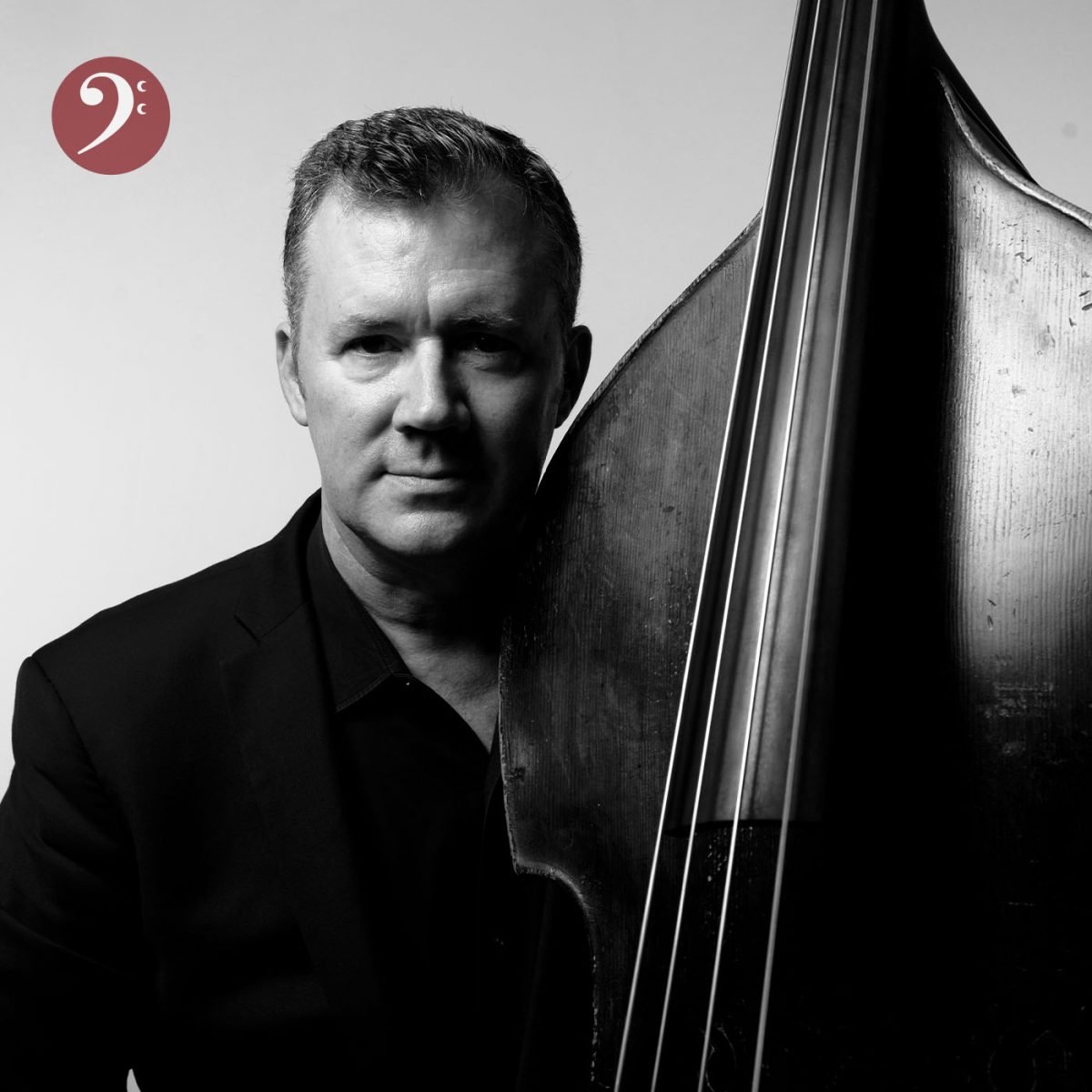
New York City jazz bassist Neal Miner joins the podcast to talk about his new book of original bass-feature compositions, a 25-song collection designed for students and professionals to use in ensemble settings. Neal shares how longtime collaborator Chris Byars encouraged the project, how the book grew into play-alongs and a My Music Masterclass, and how his work as a bassist, teacher, composer, and documentary filmmaker all connect through a patient “chip away” creative process.
We dig into Neal’s love of bass melodies, contrafacts, gut strings, his longtime Juzek bass, Golden Spiral strings, DPA mic setup, recording acoustic bass, and the realities of playing unfamiliar instruments on the road. Neal also talks about his YouTube documentaries, his trio album Invisibility on Cellar Music, and life as an active New York jazz musician.
Enjoy, and learn more at Neal’s website, follow him on Instagram, and check out his work on YouTube! Be sure also to check out Neal’s excellent appearance on Discover Double Bass.
Find the complete podcast episode on Contrabass Conversations or wherever you get your podcasts. This conversation has been edited for clarity.
Jason: I love the new book! I’ve got it on the iPad — actually, I got the Kindle version, and I was going through it while playing it. It’s a great project. That’s the sort of project that one can only do after having decades on the gig and writing these tunes or contrafacts, as you used the word. Very cool project, and I love that you’ve got the play-along MP3s that people can play with. But then you’ve also created it so that it can be done on the gig too, right? Like with the second sheet.
Neal: The goal is for either a pro player or a student at a university or a high school to be able to be featured in an ensemble in a very easy, convenient way. They can just pass out the parts. And of course, if they wanna change stuff, that’s great too, but I’m just giving them an idea of what can work. I also have a My Music Masterclass accompanying masterclass that you can purchase or rent.
When I did this project, it was many years ago — I wanted to do it so no one would say, “Oh, did you put out an E-flat and B-flat version?” Yes, I did. “Did you put out My Music?” Yes, I did. I didn’t wanna have any stones unturned, so I could kind of put the project to bed and let it have its own life.
Jason: It’s very, very cool. Projects like this can spread over a decade, you know, easily — or maybe more when you actually count the writing of the tunes. But to actually put it into a masterclass kind of form, and then to create the other books — when did this idea to actually put together something like this come to you? Was it like 10 years ago?
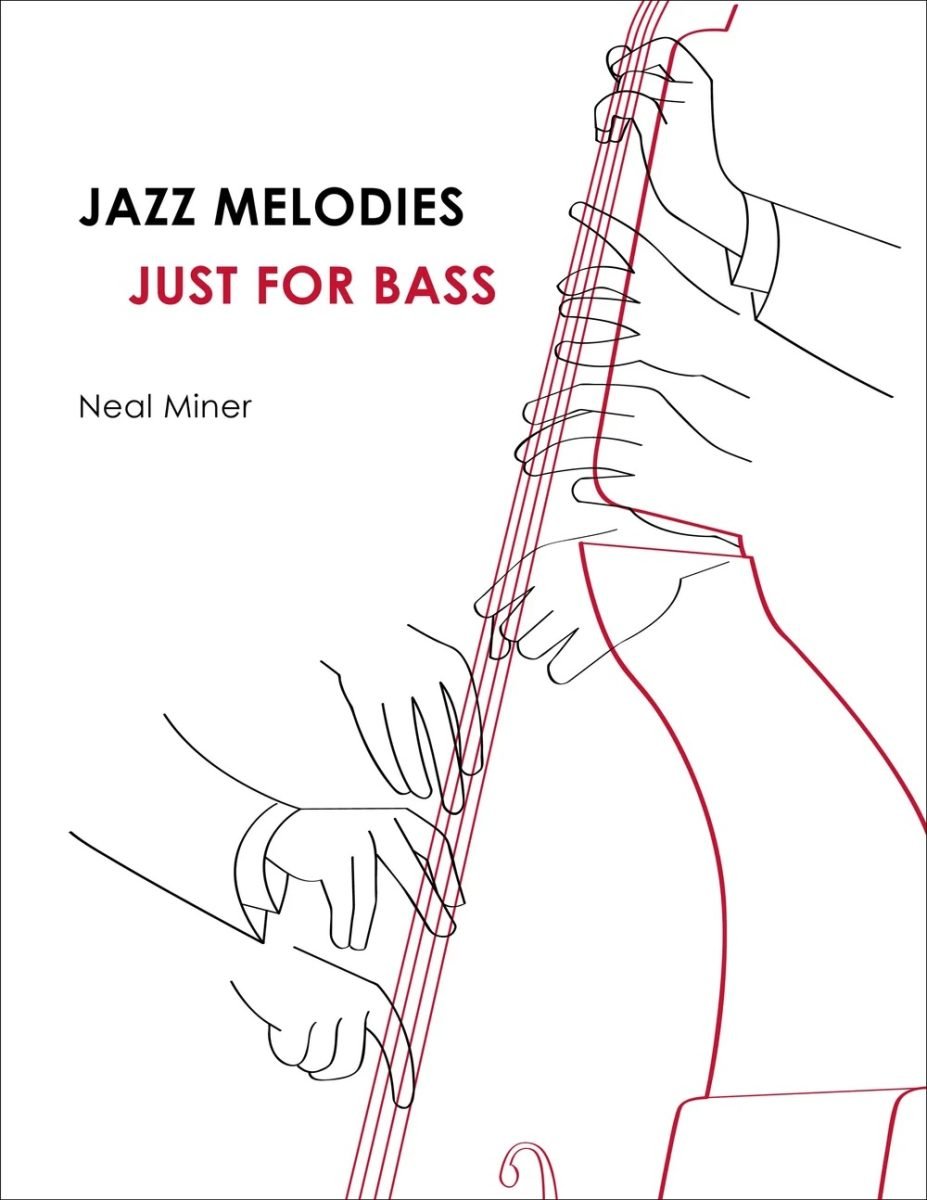
Neal: Well, I thank my partner, friend, and collaborator, Chris Byers — tenor saxophonist — for this, because he’s that kind of person. For years he’s been championing me, always encouraging me to compose. Then, maybe about 10 years ago, he said, “So when’s the book coming out?” And I was like, “Oh, Chris, come on, no.” And he just kept trying. And I was like, “You know what? He’s right. I’m at the age now where I have enough of a body of work that I could share.”
Chris was the copyist for the book as well— we worked together over many sessions. It kind of taught me a lesson in how much time and editing goes into any book, especially a music book where there’s so much subjective figuring out of how things should be laid out. It was a real eye-opener. But I’m grateful for him. He’s the one who really kept poking me to put this out, and I’m glad it finally did.
Jason: Well, I think a lot of people have an idea; they have, like, a fantasy project. But to actually press publish on the project, or figure out how to integrate it into your life — it’s not like you’re not busy. Were you chipping away at it, or did you have a couple of light months and go whole hog? I’m always interested in how people actually get something out there.
Neal: I’m kind of a chip-away type of guy. Like with my video projects — I’ve done a few documentaries that live on YouTube — some of them took three, four years. I’ll get hot on something for a minute, then I’ll get busy, and then… So yeah, a lot of these things are really hobbies for me. The tunes I had been writing — I think the oldest one in the book is from 1999.
I just gathered the ones together that I’d been playing the melodies to, and I thought it would be kinda helpful for other bass players to have some fresh material to work with, other than just the amazing Oscar Pettiford and Paul Chambers and Sam Jones and all these legends who wrote great bass lines to be played as melodies. Those were always my heroes and models I tried to live up to.
On Bass Melodies and the Challenge of Playing Tunes
Jason: Yeah. Well, it’s so great to add to the body of work. This is a bass feature! I was at a gig last night — a bass friend of mine, a guitar-bass duo gig — and he said his goal right now is to go back and learn the melodies of tunes he already knows. He said it felt like he was starting over. It’s so easy for us bass players to not play the melody and just have that chordal structure in our head. But how cool to add your material to that mix in a way that really makes it possible to do on the gig.
Neal: Yeah, I mean, it’s so true. I just don’t think we normally get that opportunity. We probably have to have our own band, or write our own bass feature, to play a melody of a standard, even. You really have to do it on your own if you wanna do it well. And I’ve always dabbled with it too, but we’re just not doing it like piano players and saxophone players and trumpet players — they’re always playing melodies, so it’s second nature to them.
I think it’s a real challenge for a bass player to play. Even for me, I feel like playing a contrafact is one thing because it’s so specific and exact about what it should be, like a Bird (Charlie Parker) head. But a standard can be interpreted so many ways—you could play it like you’re singing the lyrics. So it’s so subjective and open-ended. I’ve always found that more daunting than just playing a line that’s kind of like a Bird head or an Oscar Pettiford head, because it’s like either it’s right, or it’s wrong.
It’s one of the most esoteric things in the world to write bass melodies, ’cause it’s kinda like not what we’re supposed to be doing by trade, but it’s always fun. And honestly, I think people don’t hear it very often — audience members — so when they do, I think it stands out as something memorable from a set of music.
Jason: Yeah. That’s awesome. And I love that you put the masterclass together, actually laying that down. That can be its own gigantic project.
Neal: Absolutely. That was the last step of the project for me, and being an amateur videographer, I did it all myself. I bought a blue sheet from Amazon and hammered it into the wall as my curtain. I got my lights out, set up the cameras, and I think for about a week, each day, I just kind of… And of course I wore the same outfit each day for consistency, and I think my hair got a little longer. But I just tried to really talk about each tune like if I was teaching a lesson — “I prefer this fingering and shifting here; I think that it helps with the line” — I just tried to be honest. And then, of course, the play-along is included in the My Music Masterclass too, so if someone purchases that, they get a PDF of the book; they get the play-along. They get it all.
The Masterclass, the Documentaries, and a Love of DIY Projects
Neal: And my friend Adam Small — are you familiar?
Jason: Absolutely.
Neal: Yeah, he’s a great guy. I’ve known him for years, and I’m so impressed and proud of what he’s done with that body of work. Just as with you and your podcast — incredible, great body of work, really wonderful.
Jason: Well, I wish — you and I are roughly the same vintage — I wish that tools like ways to get in and work with somebody like that, with these digital platforms, like how cool would it have been back when I was 20 to actually be able to essentially get a lesson or a series of lessons with you, and to have the play-along and to have the music, and you can stop, you can rewind, you can go back and forth.
I spend some time every day on one of these learning platforms, whether it’s Discover Double Bass or whatever else, and I just think it’s such a cool way, whatever stage you’re in, to kind of get the gist of a lesson — maybe even better than a lesson in some ways, because it’s like you delivered your best possible version of that concept to the camera. And I think it’ll be really interesting to see, in 20 years, what it looks like when you’ve got people from all over the world that can dip in and get that level of education.
Neal: Oh, it’s incredible. Every generation in the history of the world has always had a level of talent, but I feel like this generation is just exploding because of all the information. I was lucky growing up, just having recordings. To learn a tune, I’d have to go to the Lincoln Center Library. These kids just have everything at their fingertips. Now, whether or not that gives them a drive and a hunger, I’m not sure about, because I had a hunger because it was hard to find this stuff growing up.
But I’ve noticed these young guys and gals have so much information—not just talent, but technical ability and chops. They really know the music. It’s almost like it’s sped up because of all this availability. I feel like they really have an advantage with all of this, for sure.
Jason: Yeah. It’s crazy. And using all this information is the challenge, of course. I think about back when I was like 19 — I’d have to go to the Evanston Public Library, check out the CD, then go home and put it on, or go to the listening library, write it down on a sheet of paper, and hand it in. What a dramatic change.
Neal: We only know what we grew up with, but I just remember that being very exciting — like hearing, “Oh, did you know so-and-so has a video of something?” And you have to call them up, “Oh, can I come over and see the Kenny Dorham video I heard you have?” And now you just have it all on YouTube. So I wonder if there’s a little bit of lost hunger because it’s so readily available. Who knows?
Jason: Since I have somebody who records and does video stuff and does what you’re doing with the documentaries — so if you don’t mind, can I ask you a couple of nerdy questions? I watched through the one with Bill Crow, the bass player, and then I started on the one about The Artist, your father-in-law, right?
Neal: Frank, yeah.
Jason: How do you get the idea, and then how do you put all the pieces together? Because you’ve got interviews, photography, music — what does that process look like for you?
Neal: That’s a great question, and honestly it just kind of falls into place. Each thing, since it’s like a hobby, I just kind of get inspired. I usually start with the interview — I’ll just do an interview with someone with maybe a couple of cameras and a lavalier mic, and then I’ll get that footage. Once it’s in my program, Final Cut, I find the best moments and clean it up —cut the fat out—the ums and the ahs—and get the pure footage and information.
Then I’ll start assembling it, and then I’ll have a need for a photograph, and I’ll go get that photo. It kind of just does itself almost. At least that’s how I work. I don’t usually start with an outline. I just kind of like to go with how it goes, like a gig. You just can’t plan for everything—you just have to be ready. I kind of enjoy that spontaneity and creativity that comes from these projects.
Jason: That’s cool. So it starts with the interview and kind of blossoms out from there. That’s awesome.
Neal: Absolutely. I find you can’t start with anything but the interview. The interview will dictate everything. Like, Bill Crow will say, “Oh, in 1951 I came to New York, and we got an apartment for $3 a week,” or whatever. Then I’ll go on Google, find an image of New York in 1951 with cabs, and I’ll just grab that. Because none of my documentaries are for profit, I use everything for fair use, which is nice not having to license things because that would be a fortune. I just want it to live on YouTube for educational purposes.
Gut Strings: A Long and Winding Journey
Jason: I love vignettes like that — these human stories, placing people in context. And going back to that interview you did with Geoff Chalmers — I love that you had your bass there. You got a great tone on the various projects I’ve heard of yours. You’ve got a pretty sweet-sounding Juzek that you did some work on, right? And you’ve had it for a few years — you got it in ’95?
Neal: I got it in ’95, and then a couple of years later I had kind of a major overhaul done. It had some fundamental problems that really needed to be in the shop for a couple of months, and I’m glad that I did that. I thought it really brought it to another level.
Jason: And then to hear your string journey, and then also how you’ve made the G string work for you — can you just talk a little through gut strings and your journey to what you ended up with, what you’re playing on now?
Neal: Well, it’s funny because I remember in high school when I first started really playing the acoustic bass and wanting to play jazz — listening to those old recordings on Prestige and Blue Note and thinking, “Well, why doesn’t my bass have that sound?” I was completely unaware that gut strings even existed.
I didn’t realize it until I came to some friends in New York. Ari Roland was one of them, and Dennis Irwin, and these select bass players who were gut string guys — Joel Forbes, Murray Wall, Ben Wolfe. They were like real hardcore purists — no amplification, maybe a mic, no pickup, no amp, high gut strings.
I just dove into the deep end and took my bass to David Gage, because you kind of have to set the bass up differently — a luthier needs to do a bunch of different things to make it optimal. You can’t just slap ’em on a bass that had a steel string setup. It could be too buzzy.
So I had all four gut strings — the top two were plain, and the lower two were wrapped in a roundwound kind of copper. But all sorts of problems: immediately in the summer they start turning green, your fingers turn green, they unwind, they’re super expensive, they go out of tune every second.
But they have this beautiful, unique sound that makes you realize why those old records had that sound. It comes with this price tag of just a myriad of problems.
So over the years, I tried to figure out what I loved about gut strings. I found that, for me, the distinctive sound of gut strings was the D and the G. I found the A and the E low gut strings very problematic, but obviously beautifully recorded. I felt that if I had steel strings on the bottom, it was the consistency I needed.
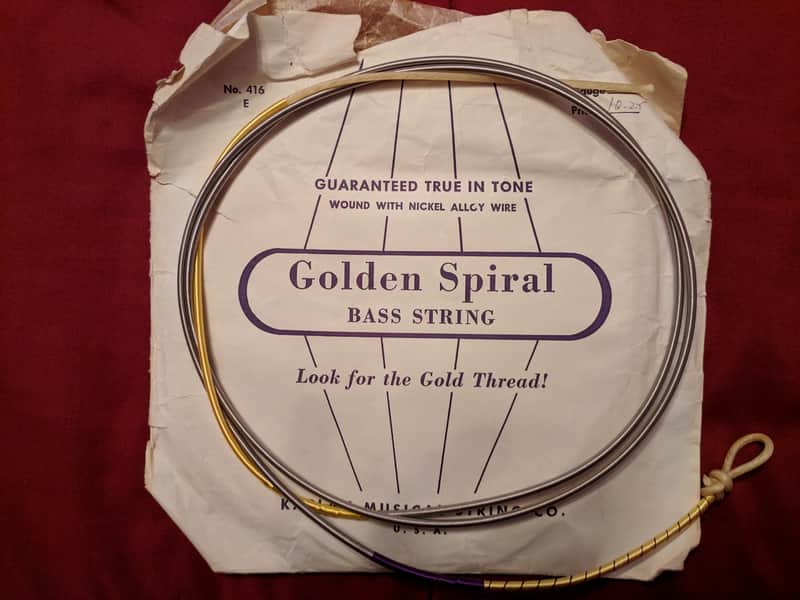
Then I found I didn’t like plain gut, so I started using the wrapped ones, and that’s where the Golden Spirals came in. The D-string Golden Spiral was always too floppy on my bass, so then I found an Oliv, which is wrapped in chrome. So in ’99 I got that whole setup — an Oliv G, Oliv D, and Spirocore medium E and A. That just worked, and I just stuck with that. I haven’t changed it since. So it’s been 27 years of the exact same setup.
Jason: But then you discover, like, 25 years ago at this point, Golden Spiral’s going out of business, right?
Neal: A friend of mine tipped me off — Kenji Rapson, who’s a wonderful bass player living in Stockholm. He somehow heard because of mad cow disease — remember that? The mad cow thing apparently wiped out the gut string market for a while. So Golden Spiral went out of business.
There was a shop, a very famous New York shop called Ideal Music on 22nd Street. These kinds of very old-world, curmudgeonly people working there — they were just always cranky, but they had everything there. I went in, and at that time I was only using the G. I said, “How many G strings do you have?” And I think they had like 40 or something.
I didn’t wanna be a jerk and take them all, so I think I took about 17 of them, which was a lot of money at that time — I was in my late 20s and they were about $60 each. Maybe it was 13 or 12, not 20. But each one lasts about five years, so I figure I might have a few left once I’m done, and I’ll will them to some young bass player.
And actually recently somebody, an old teacher, gave me a whole box of Golden Spiral strings, and instead of just hoarding them all for myself, I gave them to some younger players who really expressed an interest in wanting to try them. Dominic Duval, who’s been posting all over social media about his Golden Spiral D and G — those are from me through Rob Schneiderman, who was my first teacher. And I gave Caleb Tobman some. I gave Ari Roland some. I just wanted to share them because I’m lucky enough to have my own stash.
Jason: That’s awesome. And what a cool find for those players to educate themselves. Even if you don’t stick with gut strings, you still learn what they can do. There’s a great New York City bassist, he does more baroque stuff, named John Feeney, and he did a great video on gut strings and the ocean of sound, and he was making a comparison between gut to steel versus analog to digital recording — there’s just so much more information contained. I see you nodding, so you’ve had that same experience?
Neal: Oh, absolutely. Gut strings come with a lot of problems, but back then when they were around, that was all there was, so people just kind of dealt with it. But I can see why everyone wants steel or some sort of synthetic thing — fewer problems, more affordable, they stay in tune longer. I get it. But sometimes with struggle comes beauty. And I’m trying to use part of the struggle and part of the convenience of my setup.
I feel like once you get that and your bass likes it, I like to just not think about strings anymore — I like to just think about music.
On the Road with House Basses
Neal: But of course, I go on the road now a lot and use house basses and rental basses, and so I’m constantly being challenged with the pitfalls of bad setups and weird strings and string lengths. The bass is just a very unforgiving instrument in every way.
Jason: I’ve always been so impressed by people who do that. If I go on the road, I just make sure whatever music I play is not gonna make my life horrible. I’m so interested in talking to people who, wherever they go in the world, have to be an improvising musician and then get this instrument — and maybe the strings are two inches off the fingerboard, or it’s a 45-inch string length, or a 38-inch string length, or some bizarre D neck, E-flat neck, something in between.
Do you have some sort of way to introduce yourself to these new instruments? Do you play some B-flat blues? Do you improvise on it for a while or play scales?
Neal: I just try to do some scales — I usually just do all the scales and arpeggios, and realize that if it is a D neck or an E-flat neck, there’s that issue of the F on the G string being way higher than it normally is, and that can be very awkward. I might just stay away from the higher part of the bass.
I was just out on a tour of the Midwest with vocalist Jane Monheit, and I played three different basses — they were all super different. The last one had one of those weird necks, either a D or an E-flat, and I just stayed away from the higher notes ’cause I just couldn’t play ’em in tune. I’m there to play bass notes, so why not stay low?
But it’s frustrating. I always tell piano players — imagine if you went to play a piano and some of the keys were a different width. I don’t think people realize there’s this standardized keyboard.
We’re kinda stuck. Bass, more than almost any instrument, is such a wild card.
Jason: Yeah, it’s humbling. I think it’s one of the largest instruments that we’re kind of expected to have our own on the gig. My wife is a harpist — that’s bigger, but harp is standardized. Bass, though, my goodness. Even if you’re playing on a string length you’re familiar with, if it’s a D neck, the upper bouts — all of a sudden it feels like that F is two feet off or something.
Neal: Oh, totally. The slightest little things can throw you off. And what really throws me off is that if I ever play a five-string bass, I literally cannot play. It’s like my brain kind of shuts off because you see the low string and you think it’s the E. So I will literally just say no when people offer me one — I’ve had very embarrassing experiences with that.
Jason: And even the spacing on the five-string is different. I know there exist in this world five-strings that are optimally set up and ring beautifully, but my stereotype, sorry, five-string players, is this like thuddy, dark string with no ring kind of thing. And then yeah, I have the same thing — I’m amazing at playing on the wrong string when I’ve got that fifth string. It’s like trying to play with your opposite hand almost.
Neal: I mean, I’m sure I would get used to it, but I don’t have one, and I barely ever see them. I get it though — in certain Eastern European countries I think all orchestras have five-string basses.
Jason: Yes. And then no pickups for you, but DPAs — like, when you’re touring too, you kind of stay away from monitors, stay away from pickups, just DPA for amplification?
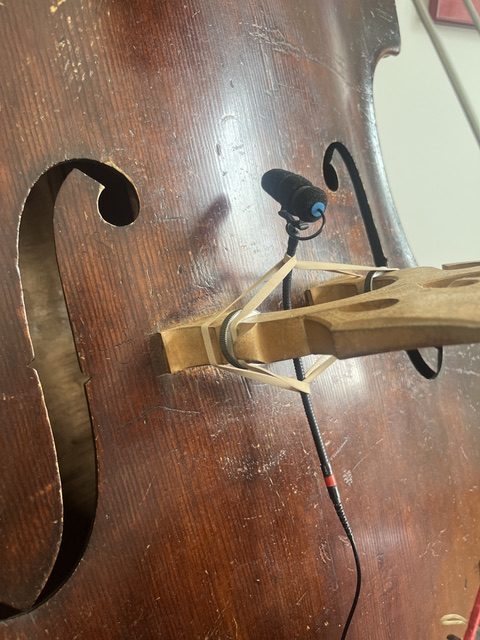
Neal: Yeah, I bring the DPA, and that’s kind of the one thing I can get consistency from bass to bass. And I don’t use the rubber clip that comes with it that clips onto the lower strings — it’s a wonderful, brilliant design, but for some reason it pulls in weird frequencies.
So what I do is suspend it between the feet of the bridge—I put rubber bands in there and suspend the DPA, and that keeps it completely free of sympathetic vibrations.
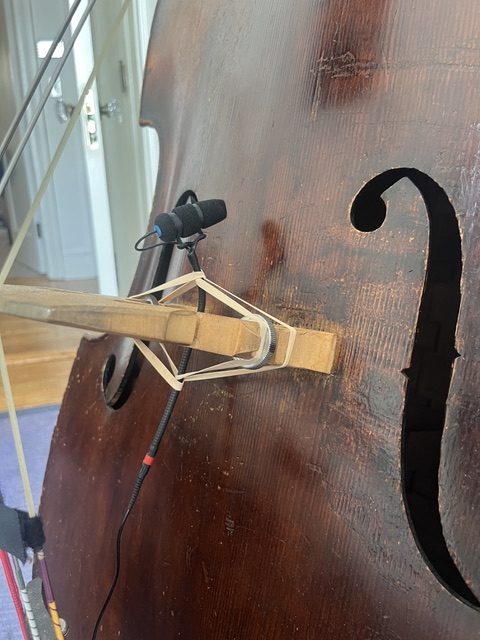
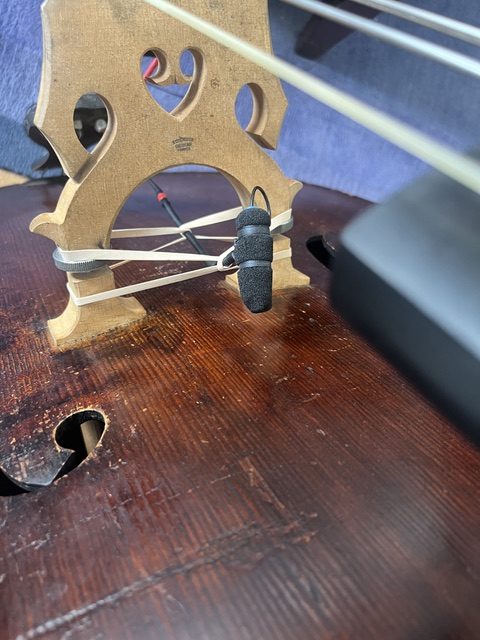
I don’t like monitors; I don’t like a piezo pickup. Actually, on this last tour I had to plug into a piezo pickup for this long, boring reason I don’t even wanna go into, and it reminded me how much I don’t feel comfortable playing that way. It throws off the sound, the feel, and the length of the note, and it just changes my feel. I’m sure I would get used to it, but I really prefer the microphone, and I committed to that years ago, and it feels right to me.
At least for the style of jazz I play. If I were playing in an incredibly loud, aggressive band, I probably wouldn’t be there to begin with. I tend to play in groups that are more acoustic or with singers, so I can get away with it.
Jason: Yeah. Well, that’s the sound we all became attracted to, right — the acoustic sound of our instrument. And you got into this with Jeff too, with sympathetic vibrations and funky things that can happen. You demo like a B on the G string, and also a B on the D string, and your E string really gets going. And you even have like some kind of felt mute on the after lengths. Can you just talk about that?
Neal: Well, yeah. I think classical players are way more in tune to that, because you always see wolf guards on classical basses. What I do is I basically just mute my strings below the bridge. I use a piece of — not felt, but it’s like that material for a cord tie for an XLR cable. It just happened to work there.
So I use that, and with my bass there were a lot of weird overtones, and as soon as I stopped them, I felt like it really focused the bass. Every student that comes over, I do that with them—while they’re playing, I hold the lower strings to stop them. On some basses it sounds better, on some basses it sounds nothing at all, and on some basses it sounds worse. So you have to find what works for you. Some basses need them to ring.
Again, another weird thing with the acoustic bass — we have to find where the wolf tones are, and my bass tends to have a lot. When I play this B, everybody is like, “Yeah, that…” So whenever I play now, I’m always kind of muting my lower strings with my right hand just so I don’t ever have to deal with that. You just do what you gotta do to make this thing work.
Recording the Bass, Juzeks, and the Life of an Instrument
Jason: There are so many variables, right? And then when an instrument has the kind of spread that the bass has — maybe 10 feet out it’s gonna sound very different than right under your ear. And I think people sometimes think, oh, maximum resonance in all ways possible.
But I remember talking to Larry Grenadier about this years ago, and he said when he would record, he actually liked taking a Shen or a bass like that into the studio because he said there’s like less information coming in. Maybe you don’t want to be having all those extra frequencies that other instruments could be living in, or that aren’t necessarily contributing to your role as a bass player.
Neal: And by the way, I love that interview — that was the interview that got me into your channel. Larry’s fantastic. No, he’s right. And people who have basses that have gigantic sounds acoustically live, sometimes those basses don’t record well at all.
Apparently, Wilbur Ware had one of the most terrifyingly big sounds live back in the day — so many people told me it was just overwhelming, almost kind of religious, how loud he was. But then if you listen on records, he sounds good, but you can’t tell from the recordings how his sound was. I think really loud bass doesn’t record as well. Something that’s very even and softer can record much better than a very loud, boomy bass with a lot of ring.
Jason: I’ve had people ask me a lot — I am the wrong person to ask — how to recommend recording a bass. But do you have preferred mics, or what do you do in a studio recording situation?
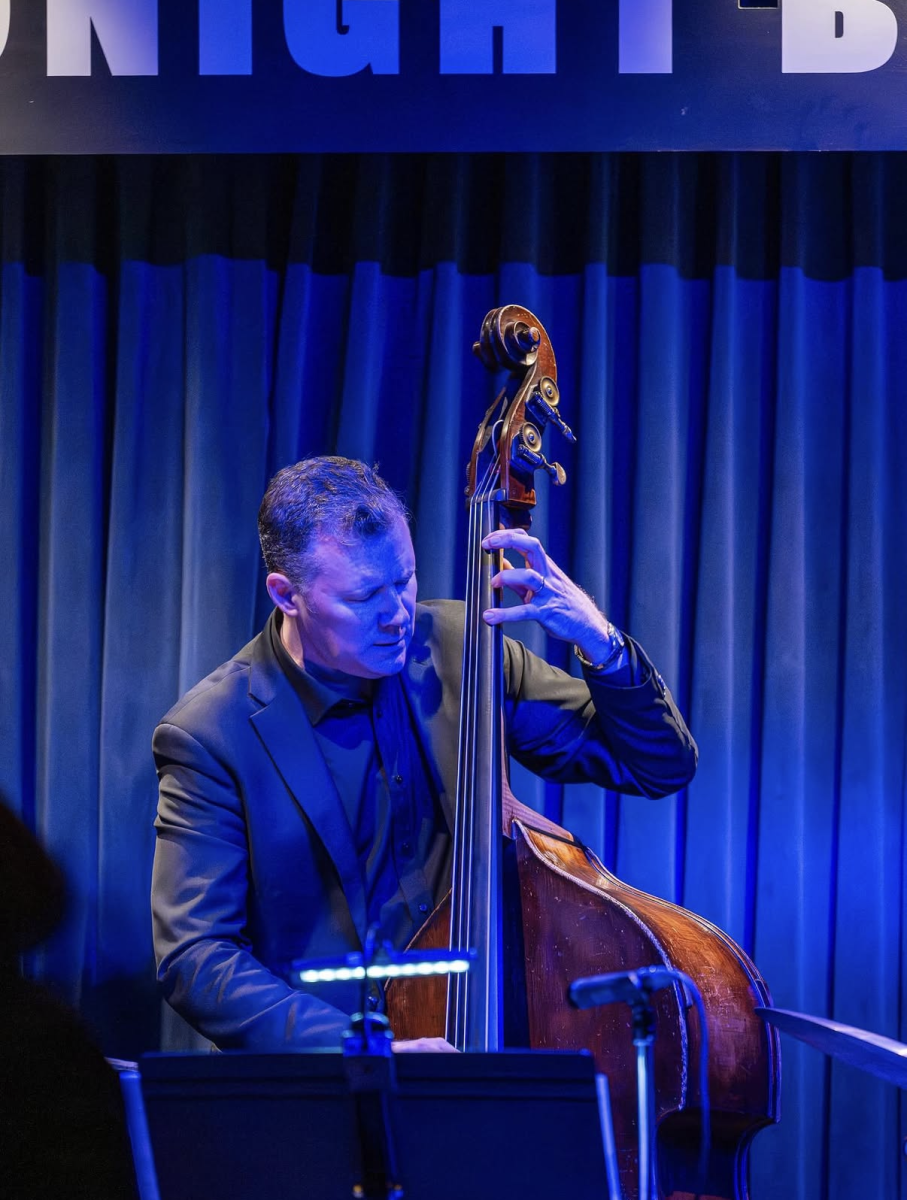
Neal: What I always do is bring my DPA, and I always offer it because a lot of times they take it. I say, “You know, if you wanna just take it, you don’t even have to use it; just take the line,” because I won’t use a pickup, and some engineers really want that.
And of course, if I’m showing up without a pickup, there’s not much they can do. So I’ll always say, “Well, I’ve got this DPA that goes right on the bridge, nice and close.” And a lot of times they’ll take it, and they really like it. But I’ll always defer to the engineer, let them set up their mics that they’re comfortable with and experienced with, and then just offer the DPA. In the end, I think it really helps to have that as an option.
Jason: Yeah. When you have a bass that sounds like yours — with that great bounciness, that big sound — what were you talking about with Jeff? Like, Juzeks. I mean, they are great for so many situations. They’re workhorses, fantastic, and they’re great arco basses too if you set ’em up right. I’ll be in a bass shop, and they’re like, “Wow, that sounds fantastic. What’s that?” “Juzek.” “Oh yeah. Cool.”
Neal: No, they really — there’s something special about them, especially with pizzicato. I mean, I don’t know what’s so magical about them. And obviously they’re seasoned because they’re older. I feel like my bass is not necessarily a screaming loud bass, like maybe like an American Standard, something like a plywood that can just be super loud but maybe not have the tone that’s as delicate and complex as you were saying earlier.
But I feel like my bass is very even and clear, and I think Juzeks have a lot of mid-range instead of just a lot of lows, which is what makes them pop out and be heard on the bandstand. Sam Jones and Paul Chambers- a lot of them had Juzeks, and you could just tell. And Ron Carter, his whole career was a Juzek.
They’re just a great combination. And there are different levels of Juzek — there’s the Jimmy Blanton one, which has a little ebony diamond on the back, and it’s got violin corners, and it’s bigger, beautifully made. I’ve always wanted one of those. But the one I have is just kind of a basic one from the ’40s, and I’m very happy with it. What I love about it also is I’m in New York, and I use the subway as my main source of transportation — it’s light, and it’s small. But it sounds big, and I don’t get complaints very often that they can’t hear it. So I’m grateful for that. Sorry for the car horn!
Jason: No, hey, that’s how we know we’re in New York City. It wouldn’t be a New York podcast without a little bit of that. What kind of bass do you play?
Neal: Yeah, no, it’s… What kind of bass do you play?
Jason: I play a Jackstadt — a modern bass, nice big 7/8. You see ’em around a lot of orchestras, and it’s nice. I had a Löwendall for years, late 19th century, and it was great. But then this bass was making the rounds when I was living in Chicago, and I took it to a couple of gigs and people said, “That’s way better than your bass.” And then the cool thing about bass — I sold that Löwendall, and then like five years later this jazz bassist in Chicago said, “Hey, I bought your Löwendall and here’s my debut album,” and I saw my bass on the album cover.
You know, that bass that was in my parents’ house in high school — it’s cool. You take these instruments, you’re the steward of them, but then they live on. We take care of ’em, and they have this legacy, and then somebody’ll be playing this Juzek in the next generation. That’s kinda how it goes.
Neal: That is so true. They have many lives, for sure. And the other thing about the Juzek — honestly, it’s like a little tank. I mean, I barely ever have it serviced. I’ve fallen on it. It’s fallen over. A drummer’s cymbal went through the side of it on the break, and it was repaired, and it’s tight as a drum. They’re just tough suckers, and they’re nice and light. I just love ’em. I’m very grateful for it.
Jason: To have a bass that sounds great, is light, and is a tank — those are like the three critical things. And that’s one thing I’ve always loved about this Jäger Strad. My Löwendall was great, but it had a different buzz for every five-degree change in temperature and 5% change in humidity. And to get a bass that’s just no problem — really hot in Chicago, no problem, cold in Chicago, no problem, raining in Chicago, no problem. I just realized how much of my life was spent diagnosing annoying bass quirks.
Neal: Oh, that’s… The thing is hard enough with all of its variables. Now we gotta deal with buzzes every five degrees of temperature. Oh, so you’re in Chicago?
Jason: I was. I live in San Francisco now. So now if I talk about a winter sound post, people look at you like you’ve got a third eye — nobody knows what that is because it’s the same temperature year-round. But I had all those temperature fluctuations for a couple of decades.
Neal: Yeah. My Juzek literally has one post, and I never change it. It does fluctuate with the winter and the summer, but Mike Weatherly (now retired), who was my luthier for years, was like, “Yeah, this bass just doesn’t need a winter and summer post.” So thank goodness — one less thing to worry about.
Jason: One less thing to worry about. That’s how the Jäger Strad was for me in Chicago too, which is crazy because the low end—it was constant. And that just shows you, the bass is the Wild West of string instruments — that’s what I always say. And that’s part of what makes it fun, but that’s also part of the challenge, just for yourself in your day-to-day life, and then certainly going on the road and discovering all the other ways that people have been trying to solve this problem that aren’t the way you have.
Neal: Yeah. No, it definitely keeps you active and interested. Never a dull moment with the bass, right?
Neal’s Trio Recording
Jason: Anything else you wanna dig into for this pod?
Neal: I recorded a trio recording of my group about a year ago, a little more than a year ago, through Cellar Live Music. Corey Weeds out of Vancouver—he’s got a wonderful catalog, and I was very lucky he chose my trio to be documented. We’ve been playing at Mezzrow in New York, very regularly, at least once a month — Chris Byers, Jason Teman.
It’s all of my original music, not just the bass melodies, but other tunes that are contrafacts. I’m very proud of that. The album’s out — it’s called Invisibility, on Cellar Music, as I mentioned. It was recorded all in one room, on tape. I’m very proud of how it came out. They did a wonderful job with the sound — no headphones, just a little bit of baffling.
We play regularly in New York — if you’re ever in New York, anybody, come check us out. But the main thing is the book, and I feel like I need to work on playing for a while and leave the projects alone for a little while.
I just honestly love to play as much as I can, and there are so many clubs now that do livestreams, so you almost don’t even need to record anymore — it’s like you’re documented more than you maybe like. So it’s a wonderful time for that. But I’m just happy to be in New York and playing, and I’m just trying to keep swinging.
We discuss topics like this every week in our email newsletter. We also offer free monthly sheet music giveaways, community news, and all sorts of cool opportunities for bass players. If you’re not on the list, consider subscribing!


