

Protect Your Bass: The Importance of Humidity Control
I want to talk to you about something that might save you from catastrophic damage to your instrument—humidity control. We have dealt with basses that had damage so severe they were beyond repair, all because of improper humidity management and string tension left on for too long.
Let me show you how to prevent this from happening to your instrument.
Why Humidity Matters
Wood expands and contracts with changes in air humidity. When we heat our homes in winter, we’re actually reducing the relative humidity dramatically. Picture this: air at 32 degrees with 80% humidity comes into your home. Heat it to 70 degrees, and the humidity drops to around 20% or even lower. This creates a hostile environment for wooden instruments.
When wood gets too dry, it becomes brittle. Think about the difference between bending a piece of wet wood versus bone-dry wood—the dry piece snaps immediately. Your bass experiences about 250 pounds of string tension pulling on the top, plus the additional pressure from your hands when playing. A dried-out top loses its elasticity and can’t handle these stresses, leading to cracks, sinking tops, and irreparable damage.
The Tools You Need
Get a Hygrometer
First things first: everyone needs a hygrometer for their bass. These cost around $20-30 on Amazon and tell you exactly what’s happening with your humidity levels. Whether you’re at home, school, or the symphony hall, you need to monitor this.

A great hygrometer that also measures relative humidity and temperature!
Target Humidity Range
I recommend keeping your bass in an environment with a relative humidity of 40-45%. You don’t need to hit 50, 60, or 70%—that’s actually too much. Consistency in the 40-45% range is ideal.
Temporary Solutions vs. Real Solutions
Temporary (Good for Travel)
I’ve tested a few products that work as temporary measures:
- Boveda Humidity Control Packages: These two-way humidity packs (originally designed for cigar humidors) can add or remove moisture as needed. I held one in my hygrometer and watched it stabilize around 49%. They’re neat little silica gel-based packets you can place inside your bass.
- Dampit or Sponge-Based Humidifiers: You can wet a sponge-based device and place it inside your bass for short-term protection, like when traveling or bringing your instrument out in cold, dry conditions.
Important caveat: These only moisturize the inside of your bass. They don’t help your neck, fingerboard, bridge, or other external components. You need humidity control for the entire environment, not just inside the instrument.

An excellent choice for travel and other applications!
The Real Solution
For reliable, long-term protection, invest in a large console evaporative humidifier for the room where your bass lives. This maintains consistent humidity year-round.
I generally don’t recommend misters because they can leave moisture settling on the instrument, though they can work effectively in larger spaces. The key is maintaining stable humidity year-round—winter, summer, fall, and spring.
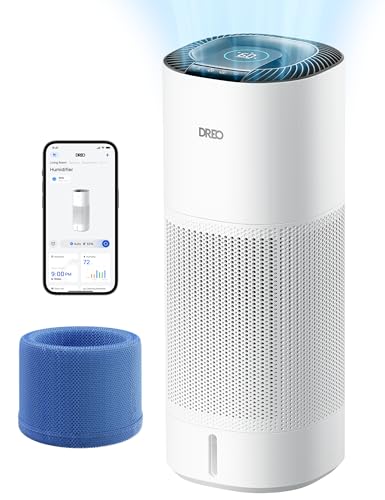
A great no-mist option to keep your double bass in an optimal environment.
The Dangers of Too Much Humidity
Before you think “more humidity must be better,” let me stop you there. If you live in Florida or Hawaii without air conditioning and leave windows open, your bass can become waterlogged.
A waterlogged bass causes equally serious problems: cracks, opening joints, backs separating from the body, warped backs if the soundpost is installed, and broken center joints.
I see college students make this mistake all the time—they get a humidifier, fill it, forget about it, fill it again, crank it up, thinking more is better. Please don’t do this!
Err on the side of being conservative and consistent, like watering a plant. You don’t want to drown it one day and forget it for three weeks.
Real-World Damage
Let me give you an extreme example. I recently saw a bass with a sinking top that had been neglected for so long that it needed a complete top replacement. Someone had previously attempted repairs—adding a new bass bar and spline—but the damage was too extensive.
With no tension relief and continued use under 250 pounds of string tension, plus the pressure from playing, the top just kept sinking. When you pull on your E string and look down the top, you can see it flexing. That constant in-and-out pressure on brittle, dried-out wood is a recipe for disaster.
Success Stories
I have a flatback bass from 2018 that’s traveled around the world—Japan, Illinois, Maine, Connecticut. Flatback basses are known to be temperamental, yet this one has never had a problem. Why? Proper humidity management.
On the flip side, I could take a healthy bass, leave it in my car for a couple of days in winter, bring it into a warm house with a wood stove, take it to a gig, and create serious problems in just a couple of weeks. Leave it in a hot car in summer with the string tension on? You’d have popping seams, a warping back, and people saying “see, flatbacks are problematic”—when really, it’s all about how the instrument is treated.
My Recommendation
Here’s what I do: I keep my basses in a controlled environment at 45-50% humidity. When I take them to gigs, they might stay in the car briefly, but I always get them back home to their safe environment. This regulation is key.
For travel, sure, use a Dampit or Boveda pack. But understand these are temporary solutions. Your home base (pun intended) should be a properly humidified space.
The Bottom Line
When the heat is on, it’s time to worry about humidity. I’m trying to make you paranoid here because I don’t want to fix basses that don’t need fixing. The damage we saw in that recent video was absolutely irreparable—the kind of thing that makes me never want to see happen to another instrument.
If you have questions about humidity control or want to discuss the science behind it, feel free to reach out. Take care of your bass, monitor that humidity, and keep your instrument healthy for years to come.
Stay safe out there, and remember: humidity, humidity, humidity.
We discuss topics like this every week in our email newsletter. We also offer free monthly sheet music giveaways, community news, and all sorts of cool opportunities for bass players. If you’re not on the list, consider subscribing!


