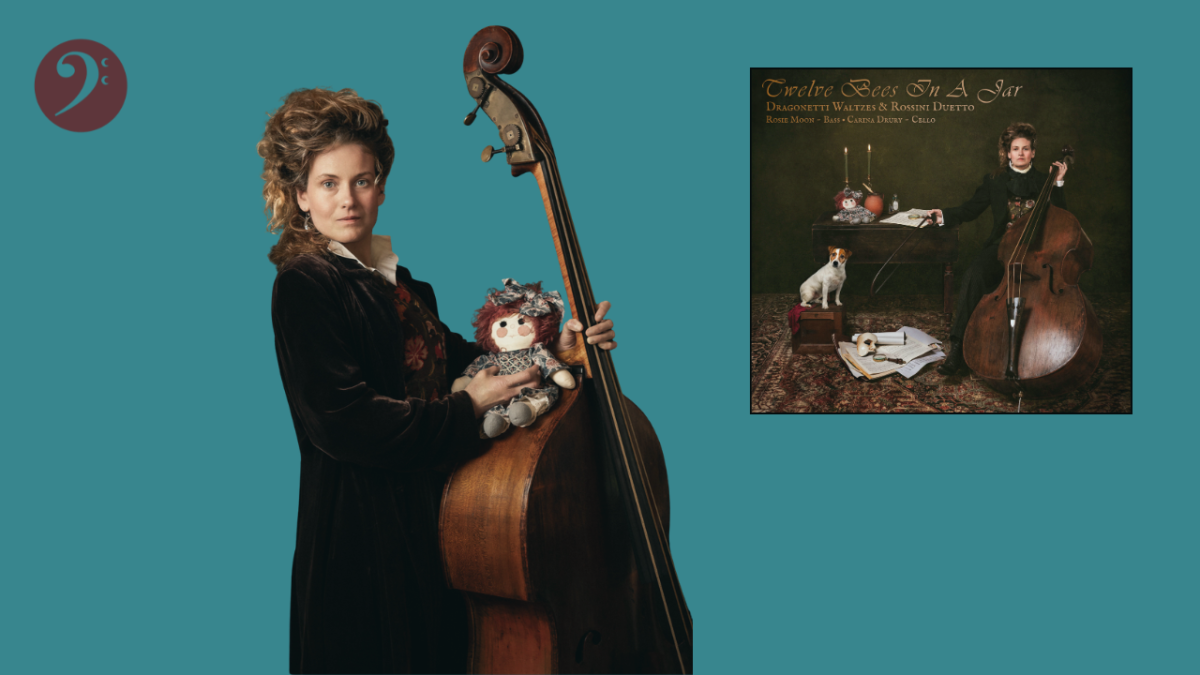
Bassist, improviser, and genre-crosser Georgia Wartel Collins joins us to talk about the winding path that led her to New York, via Gothenburg, Trondheim, and Amsterdam, and how a deeply musical family shaped everything from early street performances to a life that’s always moved freely between styles.
Georgia also shares how rock and grunge became real creative fuel alongside a love of melody, and why the upright bass, alive and changing every day, keeps offering new colors to chase. This conversation has been edited for clarity.
Georgia’s Musical Background
Jason: What you do and what you’ve done is really cool. I love the rock stuff with you and David — it’s so groovy. I listened to some of the soundtrack you did recently and then your new free jazz album, Celebrating Live. It’s really cool how you’re singing, and your bass playing is awesome. You’re now on my follow list, and I can’t wait to keep listening to what you’re up to.
Georgia: Thank you. It’s been a journey. This rock thing just happened to come to me when I moved to New York. There’s something with this city that has this rock atmosphere I tapped into, and Rock Tunes came pouring out. It was all jazz before, but now rock as well. It’s fun to let yourself not stick to one genre — to just explore whatever you feel like doing.
Jason: That’s so cool that the move to New York sparked the rock. You can see the Ramones walking down the street, or David Bowie — it does have that. But it’s cool that it kicked that off in you.
Georgia: Definitely. It’s something with the city, the lineage, the history.
Life in New York & Growing Up in Gothenburg
Jason: How long have you been in New York?
Georgia: Two years.
Jason: Did you grow up in Gothenburg? I have a couple of bass player friends in the orchestra there — Jennifer Downing and Charlie Duramis. It seems like a pretty groovy, musical town.
Georgia: Definitely. It has a lot of different genres — classical, jazz, and rock. A lot of rock. I can feel where that came from for me, growing up in Gothenburg. There’s also a more traditional jazz scene and an improvised free jazz scene. A lot is going on.
An Artistic Family
Jason: You have an artistic family background, right?
Georgia: Yes. My dad is a jazz saxophone player, and he owns a jazz club in Gothenburg for free jazz and improvised music. I grew up in that jazz club — he’s had it for about 30 years, as long as I’ve lived. It’s been a blessing to grow up with him and to play with him. My uncle is a really good jazz drummer, so we formed a trio early on, and my cousin is a good piano player. A lot of music in the family.
Jason: Did you ever think you were going to do anything else? You were born into it — was music just always it for you?
Georgia: That was not a question.
Jason: Wow.
Georgia: It’s a blessing. My mom is also a performance artist who sings, so I’ve been working with her on her performances and theater pieces with music as well. To be able to collaborate with your parents is special.
Jason: A lot of folks I interview were either from completely non-musical families or totally musical ones. I rarely hit somewhere in between.
Georgia: Exactly.
Studying in Trondheim
Jason: You did some of your schooling in Trondheim, which I’ve heard great things about. Another friend of mine, Aaron Olguin, was the principal bassist in the orchestra there. What was studying there like?
Georgia: It was wonderful. That school really fits me well. It’s a small university — they accept about 12 people every year, so classes are really small. Their focus is ear training and creating your own music, finding your own voice. We didn’t have a lot of class hours, so we had a lot of free time to just play together, form bands, and write music.
There were a lot of venues in the city where you could try out new material. It was a very creative three years — a real creative bubble. They seemed to accept people who like to work on their own with self-drive, so it was a good match for forming bands. The city itself is also magical — about 200,000 people with forests all around. Nature combined with the city. A really special place.
Jason: I’ve got to get there. It sounds marvelous.
Master’s in Amsterdam During the Pandemic
Jason: And then you moved to Amsterdam after that?
Georgia: Yes, I did my master’s in Amsterdam. It was during the pandemic, so I didn’t get to experience the full Amsterdam experience. But it gave me something — it was good to have something to focus on during that time. The school was open, venues were open to some extent, and I got into the improvised scene and that community outside of school as well. It wasn’t totally locked down the whole time, so it was a cool experience overall.
Jason: It’s crazy talking to people who were in school during the pandemic. One of our most recent guests here in the San Francisco Symphony started school right in 2020 — what a different experience. Were you in Amsterdam for two years?
Georgia: Yes, two years.
Jason: When I think of Amsterdam, I put it in the category of New York City, Paris, or London — one of those big global cities. It seems like there’s so much going on there, different pockets of creativity. Improvised music, noise music, straight-ahead — it seems like you can really find your level in Amsterdam.
Georgia: Definitely — a lot of different pockets of genres to dive into. I discovered the noise scene. It was underground, not outspoken, so I didn’t find it at first. But then a friend brought me to this really cool concert under a bridge — really vibrant, weird noise music all night. It had a similar feeling to New York. The energy was so strong, maybe because of the times, music felt so necessary.
The improvised scene was also very vibrant, high-energy, and very open. I felt very welcomed to jam and play. The straight-ahead scene had a lot of venues, too. And just walking down the street — people from all over the world, dressed however they want. Very free. I felt accepted, the same as here in New York.
Jason: You’re making me excited — I’m going to Amsterdam in about 13 days, so I’m going to seek out some noise music under a bridge. I remember my first live concert in 2021 here in San Francisco — a blues band outside on the waterfront —and I felt like I was never taking live music for granted again. I can imagine how exciting that must have been.
Moving to New York
Jason: What prompted the move to New York?
Georgia: I was living in Norway and felt I wanted something new — a new city, a new wave of energy. I was playing a lot in Norway across different bands and settings, but I felt I needed more time to develop my own music. I needed to get to a new place.
I was thinking about Berlin — I went and thought, maybe. But then I was on tour and got a request to join a tour with a band I hadn’t played with before: Devin Raja’s band, a spiritual jazz group from New York led by Devin Waldman. He emailed me through a common friend in Norway. So I joined this tour with people I hadn’t met — half based in New York, half from Europe. The tour was only two days, but the vibrations were so high, such a good vibe and great music. That’s when I got the idea: why not move to New York? I had a connection now. It was pure inspiration from that tour. So I made space for two months and just did it. Very spontaneous. I moved for two months, but then stayed longer — which I hear is usually the case.
Jason: Stephan Crump — a really cool bassist who does a lot of free and improvised stuff — has been in Brooklyn for about 25 years. He was there momentarily, and before he knew it, he had two kids and had settled in. As an artist, in what you do, it’s just an unbelievable scene.
Georgia: Definitely. The energy of the music here is really something else. Really powerful.
Influences: Grunge, Rock & Expanding Artistically
Jason: I love that New York got you headed down the rock direction. When I researched you, I found a livestream you did with Devin, and I listened while walking the dog. You were talking about your vocal warmups and practice. I sort of assumed you started on voice first, but singing and guitar are both relatively recent for you, right? Before we get there, was it bass from the very beginning as a kid, or did you play anything else?
Georgia: I started with the trumpet, actually.
Jason: Get out of here!
Georgia: Really! When I was about six, my dad kind of chose for me. He said if you’re going to play trumpet, you have to start early. So he got me a trumpet. At the time, he was playing in a Balkan band, and I was really inspired by that music. I wanted to play those tunes on the trumpet. So he taught me Balkan tunes, and we played on the streets — with him and my cousin on snare drum. Trumpet was my first instrument. I also had some piano and drum lessons, but mostly just playing at home with family and their friends.
Jason: And then?
Georgia: A guy walked by while we were playing on the street and said he really wanted to form a band with us. He was from New York but living in Gothenburg, a visual artist who also made music, named Gabo. So we went to his studio and recorded an album, then started playing shows. My dad, me, my cousin, and Gabo. On the recording, they needed some bass, and I said I could try. That was my first introduction to playing bass.
Jason: That’s so unusual. You played trumpet to the point of being on albums, and then moved to bass. Have you picked up a trumpet in the last couple of years?
Georgia: No. It’s too bad I didn’t keep it up. We still have it at home in Sweden, so I can make sounds and play a little, but I haven’t focused on it. Maybe someday.
Jason: It’s probably like riding a bicycle — you just need to get those chops back.
Georgia: The chops are the thing — you really have to play every day to maintain them.
Jason: I know exactly what you mean. During my music education degree, I had to learn every instrument for about three months. My first was trombone — I’d never played a brass instrument. My teacher eventually just picked it up, played a few notes, and said the instrument was fine. It was just me. When I got to trumpet, I remember thinking: what a different experience this is compared to bass. You’re the main character on trumpet versus the supportive role of the bass player.
Georgia: That’s exactly what I felt. Not as an active thought, but when I found the bass it felt more right — more me as a person. I wanted to be part of the tune throughout, rather than doing a solo. Yeah, it felt more right.
Electric vs. Upright Bass
Jason: Was it electric bass first, then upright?
Georgia: Electric first for a few years. Then my dad — being a jazz saxophone player — said I should play upright bass. So he just bought me one for my 16th birthday. He said, “Here’s the upright bass.” I said, but I play electric. He said, “You’re going to play upright bass soon.”
It took me about a year to accept that I was going to play it as well. But then I did, had some lessons at high school, and it felt really right. I was getting more into jazz, and upright felt more fitting.
Jason: For the more improvised stuff, especially, all of a sudden, with upright, you’ve got this incredible noise machine. You can play pizzicato, arco — it’s a drum, it’s everything. There’s an analog beauty to the upright bass that I hear you exploring in many of your projects.
Georgia: Definitely. That’s really the biggest part of why I play upright.
The sounds you can get out of it with the bow, the noise aspect, the different textures. Every upright bass is unique in its sound because it’s wood — it’s alive, moving with the moisture in the air. It sounds different from day to day, and each bass sounds different because of the different types of wood. You can never fully get a hold of it because it keeps developing and changing. It’s like a new palette of colors every time you pick it up. That’s a really inspiring aspect of the bass.
Jason: That’s the frustration and the beauty of it, right? And I think people who don’t spend a lot of time in the improvised world might think, oh, you don’t have to have chops to do what you do. But the technical proficiency it takes to play creative, improvised music is extraordinary. I spent some time with Mark Dresser — he’s in San Diego — and the technique this person has is remarkable. The same is true of so many improvised bassists.
Practice & Technique
Jason: I’d be fascinated to know what your practice sessions look like. We’ve got a bassist here in the Bay Area, Jeff Denson, who studied with Mark Dresser, plays straight-ahead jazz and a lot of improvised stuff, and sings. I talked to him about this: are you just practicing scales? How are you finding certain techniques? And then with singing and guitar now in the mix — how does your time putting in the work look these days?
Georgia: I’ve never actively practiced different textures or thought, what can I do? That’s mostly come from playing with people — trying to find a sound I’m hearing in the moment, rather than making the same sound as someone else. A lot of it also stems from something physical, something from my body.
I feel like doing this with the bow on the strings, which creates a specific texture — it stems from an inspiration from the arm. It’s hard to explain, but those textures have mostly emerged from playing with people, not from the practice room.
In the practice room, especially when I was studying in Amsterdam, there were a lot of standards, traditional jazz, and technique. I had a really good bowing teacher there who was classically trained — a lot of open strings to a metronome, changing strings smoothly with the bow, bow exercises. Nowadays, I mostly just improvise with myself in the practice room. Not so much learning standards anymore — more just playing.
Jason: You built this foundation over the years, and now you can fly. I taught at a conservatory in Chicago where my job was to teach jazz majors classical lessons. I always tried to figure out what would actually help them, since they were all going to play standards or improv. We did some combination of scales and arpeggios.
Georgia: That structure was really helpful for me. Since the music I play is so free, it was good to have that very strict structure from the teachers in Amsterdam — scales and bowing technique. I also completely changed my left-hand technique in Amsterdam, switching to the grouped 1-2-3 fingering approach. It was a lot of work getting that in, but good to have something very practical — something you knew exactly what you were going to do when you went into the practice room. And it helped the free music I play as well. Everything helps, I feel.
Jason: Exactly. You get those things into your nervous system, and it compounds over every gig, over months and years. Makes a huge difference.
Georgia: Definitely.
Grunge, Nirvana & Musical Inspirations
Jason: I read somewhere that grunge was a big influence for you — Nirvana, Elliott Smith. I can totally hear it, especially in the rock stuff. That’s my generation too. I remember when “Smells Like Teen Spirit” came out — I was doing my All-State Honor Orchestra. And we’ve actually got Kurt Cobain’s jeans two blocks from here at the Levi’s headquarters.
Georgia: The ones he actually wore?
Jason: Yes — at some point, yes. I, too, am a fan of grunge and was obsessed with Seattle. Do you find it bleeds into everything you do?
Georgia: Definitely. It’s an energy thing. I love the energy in grunge — the hardness combined with the emotional aspect. Beautiful melodies on top of really distorted, hard guitar chords. It has both the ethereal and the dark, harder side. That’s what I love. And it’s really an inspiration when I play jazz as well — to have that same push you get in rock music.
Living here in New York I’ve also discovered screamo. Some friends play in screamo bands, and it has that same energy I love. It’s the same energy I want to tap into when I’m playing any type of music — free jazz, everything. Just giving it all and forgetting about everything else. It’s really inspiring.
Jason: I hear it in your music. I grew up in a small town in the Midwest, and my first band was Toxic Death — our EP had songs called “Garments of Blood.” I always thought of grunge as punk 2.0, not really what it was, but they share that energy. And with Nirvana, especially Cobain, was an amazing melodist. His melodies are really beautiful.
Georgia: Really beautiful. And he was a big Beatles fan — you can hear it. The way John Lennon writes melodies has the same tenderness and emotional quality. You can really hear those inspirations in Cobain’s music. He’s such a good songwriter.
Singing, Guitar & How Everything Connects
Jason: Guitar and voice are both relatively new. It sounds like you’re actively working on them — vocal warmups and so on. I find that everything I do informs everything else. When I practice German bow, my French bow gets better; when I practice jazz, I listen better for classical gigs. What’s your experience been like broadening into singing and guitar?
Georgia: I really feel it seeps into everything. Singing really helps the ears — it awakens them and improves pitch and improvisational skills with people. Your voice is so much a part of you, so it comes out in the instruments as well, in the bass and guitar. It’s been really helpful and cool to get into singing.
With guitar and chords, I now hear more notes when I’m playing bass, since I’ve dived deeper into harmony. And because I’ve practiced so much on the double bass, I know how to practice, which helps me progress in singing more quickly. I can set up steps for myself and know what’s most effective — and that transfers to any instrument. Everything’s connected.
Jason: Isn’t it amazing how learning how to practice one thing carries over? A couple of months ago, I got asked to do a gig, and at the end, I was told there was one electric bass tune. He didn’t mention how hard it was — a walking bass line that kept modulating. My brain doesn’t work as fast on electric, but I know how to practice. Every day, I sat down with the metronome at 40 and worked it up. I got to the gig and nailed it. Teaching yourself how to learn an instrument is a skill in itself. And if you pick up that trumpet again someday, we’ll hear it on an upcoming album in no time.
Georgia: Exactly. Who knows — maybe a Balkan wave will come to me again!
Georgia’s Future Plans
Jason: Georgia, I’m so glad we got connected, and you’ve got a new fan here. I’m amazed at how many projects you’ve been involved in. When your travels take you to the West Coast, please let me know. I live in a really fun part of town — the jazz and nightlife part of San Francisco, right on the waterfront. I’d love to take you around or come see a show.
Georgia: I’m actually in San Francisco fairly often, because my mom is from there.
Jason: Get out of here! Really? Well, please let me know. We’re in North Beach — it’s really vibrant. I’ll send folks to your website, the new album, and Instagram. Anywhere else you want me to send people?
Georgia: Instagram is where I’m usually active. The website is also great. And I have a bass album coming up — I’m finding a home for it now, but I’ll post about it on social media when the time comes.
We discuss topics like this every week in our email newsletter. We also offer free monthly sheet music giveaways, community news, and all sorts of cool opportunities for bass players. If you’re not on the list, consider subscribing!