One of the aspects that attracts many to the idea of a career as a professional musician is the promise of Fortune, Fame, and Groupies. I wanted to insulate myself from the corruption of such material pursuits, so I chose a path in Classical music where I was assured that this would never be an issue. So far, that has proven accurate, but all kidding aside, one of the actual draws for me was the idea of “A Quest Without an End.” I knew I could find lifelong fulfillment if I chose a path where continuous growth and study were possible.

Growth via practicing is obviously a process of improvement, but it is important to note a distinction between 2 different types of change and how they impact our daily work. The Japanese have specific terms for these kinds of growth derived from their post-war interaction with Dr. Edwards Deming. Deming was a consultant to Japanese Industry after the Second World War and helped transform the quality and philosophy of Japanese manufacturing.
His work is largely responsible for the turnaround in Japanese Industry beginning in the 1950s, and he is frequently called “the father of the 3rd wave of the Industrial Revolution”. Deming introduced a concept and strategy for continuous, small-scale improvement. Over time, this transformed Japan into an economic powerhouse.
The core of Deming’s approach is known as the PDSA cycle. This is sometimes called the PDCA cycle, but the distinction in the 3rd step is crucial. PDSA stands for:
Plan
Do
STUDY
Act
The Plan stage is about brainstorming or designing a strategy intended to improve a specific, small-scale change in your approach. The possibilities at this point are literally infinite, but they can include anything from concepts (phrasing, expression), to the “whats” of playing (fingerings, bowings), to the “hows” (preparation, release, examining excess tension). T
he Do stage is exactly what it implies: execute your plan. The 3rd stage is where the real work begins. In the PDSA-cycle the goal is to Study the results of your action and see what you can learn in order to further refine or alter your plan.
The Plan is always based on a hypothesis (e.g., “I might get X result if I do Y”), and the Study phase is about gaining knowledge to refine the hypothesis. Deming stresses that the need to develop new knowledge is always guided by a hypothesis.
The 3rd step in the PDCA-cycle is CHECK, and not study, and it is more about confirming the efficacy of implementing “The Plan”. The PDCA-cycle would come in later in the process and is less about learning and more about evaluation. It is extremely important to make this distinction, as applying the PDCA-cycle too early in the process leads to the “Pop” definition of insanity: doing the same thing over and over again and expecting different results. “Act” is distinctly different from “Do”. It is the stage of the process where we either adopt the plan or make further refinements to our hypothesis and run the cycle again.
Kaizen vs. Kaikaku vs. Kaiju
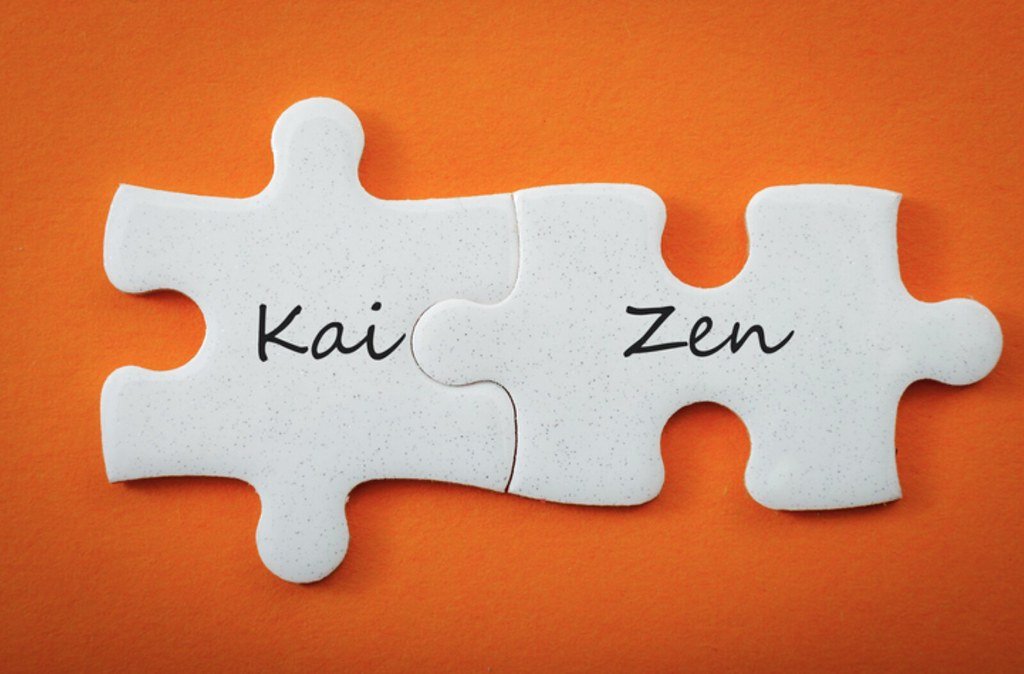
Japanese industry adopted this approach and gave it a new name: Kaizen. It is derived from the word “Kai”, meaning “change”, and “Zen”, meaning “good”. Together, it means “continuous improvement.” The concept of Kaizen is both the act and the philosophy it implies. It is a strategy for ongoing change and a general attitude that values and seeks out this kind of approach. “Kaikaku” is a term that means “radical change or innovation.”
This strategy is frequently prized in Western society as it is more outward-facing and makes a clean break from the past (think New Year’s resolutions). Kaikaku has its place in growth, as we have all experienced an epiphany or breaking through a plateau. The idea is not to rely on this kind of approach. When faced with a “wall” in practice, you can continuously bang your head against it, and potentially break down the wall over time, but a constant reevaluation of strategy might reveal that there was a ladder off to the side the entire time.
This is not to say that dogged persistence is not effective. Kaizen doesn’t always have to mean changing your approach. For me, it is the high valuation of continuous improvement and noticing the effectiveness of your approach over the value of the approach itself. Through reflection, you might find that “banging against the wall” is an appropriate strategy for a given challenge, as long as you notice and celebrate the progressive dents in the wall despite your bloody forehead.
Emphasis on Kaikaku can lead to overwhelm, as the focus is on radical innovation in order to solve a challenge rather than incremental improvements to break down the task into manageable steps. Our personal hurdles can frequently seem like Kaiju (think “Godzilla”), which cannot be defeated by conventional means. At first, they appear to be an insurmountable obstacle. I would pose a question that is a variation on a common parable:
How do you eat a Kaiju?

One bite at a time.
Check out more Fractal Friday writings here.
About the Author
David Allen Moore, 4th Chair Bass of the Los Angeles Philharmonic since 2000, was previously a member of the Houston Symphony. He is an internationally sought-after Guest Principal and has performed with the Helsinki and Israel Philharmonic.
Moore is the author of Fractal Fingering, a required text at notable universities. He joined the USC Thornton School of Music’s full-time faculty in 2010 while maintaining his position in the Los Angeles Philharmonic. He also teaches at Domaine Forget in Canada and DiscoverDoubleBass.com. His students hold positions in orchestras globally.