

In Art, Negative Space is defined as “the area around and between a subject.” A thing can be defined by what it is or by what it isn’t. We can focus on the thing itself or the context in which the thing exists. I find that the true nature of of most things exists in the “negative space”.
For example, when first learning to shift on a string instrument, the focus is on the act of shifting itself. It is only at a more advanced level that we come to understand that preparation and release are everything, and the shift is actually the moment of LEAST activity.
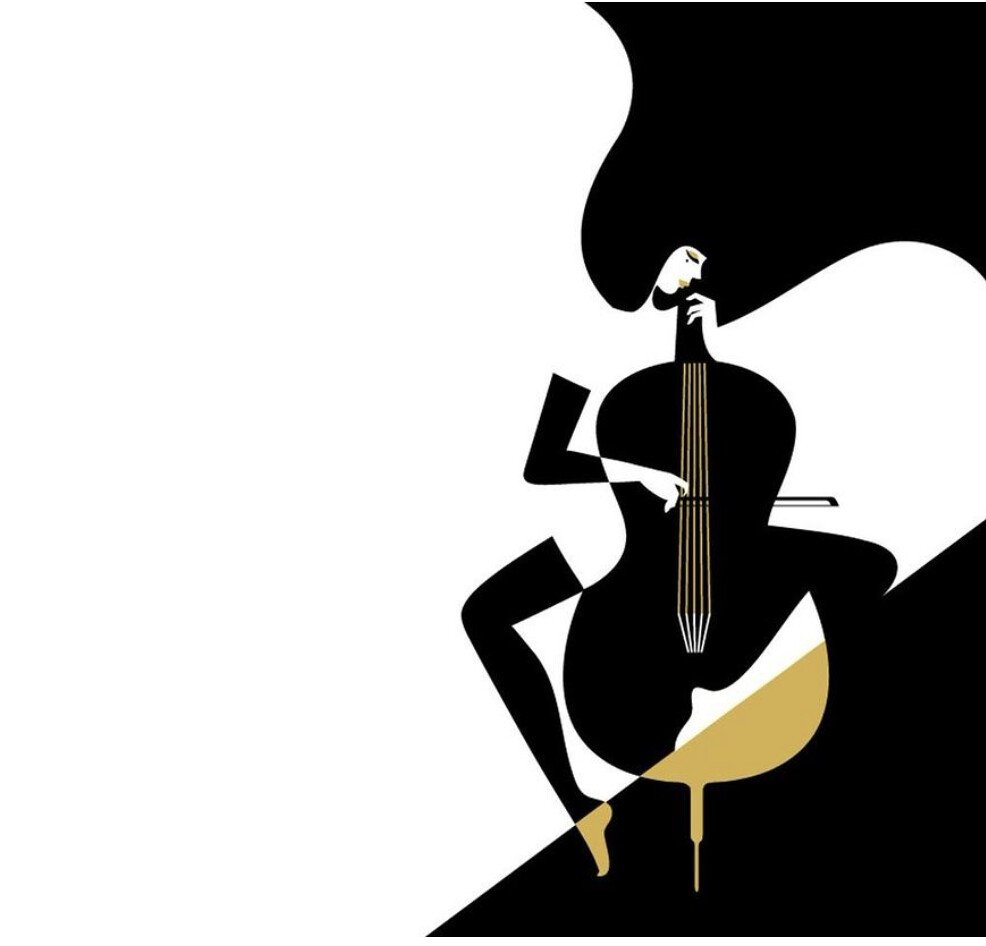
This principle has a vital role in the vernacular of “Fractal Fingering”. No note or fingering is ever viewed in isolation. It is by being more specific and consistent about context that reliable intonation is achieved. One of the goals of this approach is to create a detailed ideation of the entire fingerboard. The best way that I can describe it is to imagine the fingerboard as a grid with an LED light at every half step. When you play a passage in a particular key, ALL of the notes that correspond to that key “light up” in your mind’s eye, not just the notes you are playing.
The most basic expression of this is to always think of notes in thumb position as “thumb and…”. In other words, we want to retain awareness of the location of the thumb on the fingerboard regardless of whether or not it is actually being used to play a note. You can begin to engage with this experience by examining several of the ways that we can conceive of the note “B” in thumb position on the G-string, played with 1st finger, a major third above the octave.
When relating to 3 diatonic pitches on one string, this B can be the middle of a half step plus a whole step, a whole step plus a half step, or two whole steps. The first configuration would yield a thumb on A#, 1st finger on B, and 2nd or 3rd finger hovering above C#.
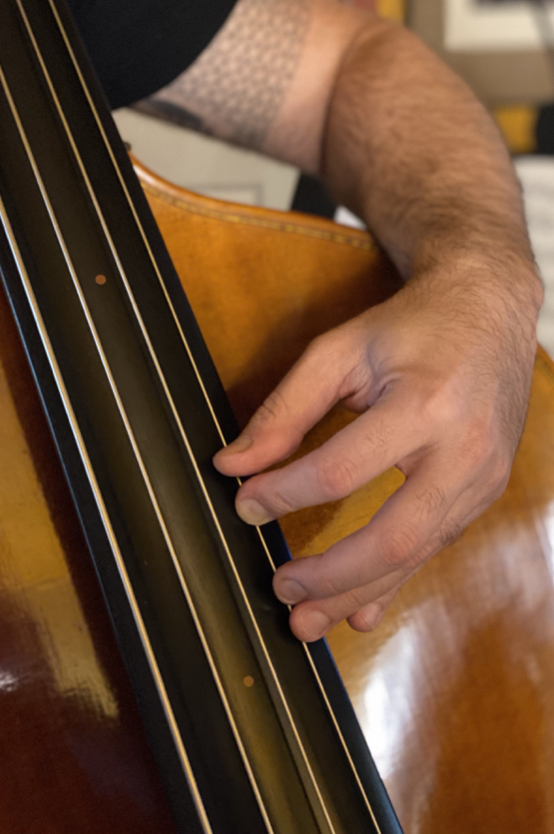
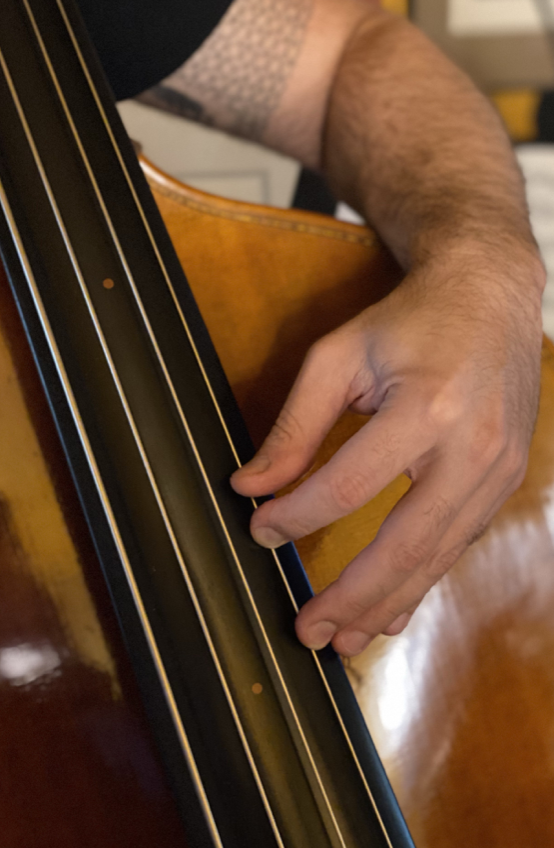
This can be conceived of as scale degrees 7-1-2 in B Major, 3-4-5 in F# Major, 5-6-7 in Eb minor, etc. The specific concept of the context will be determined by the music.
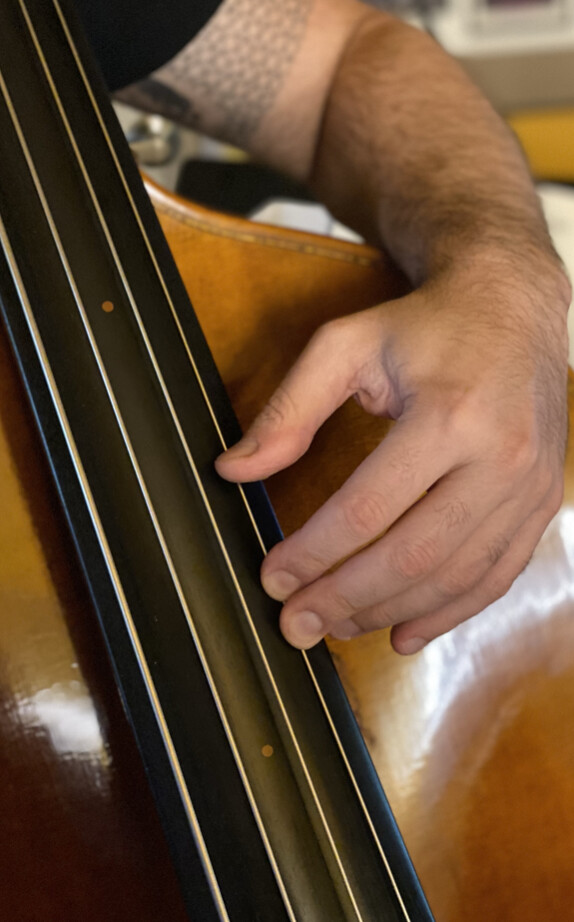
A whole step plus a half step gives you thumb on A, 1st finger on B, and 2nd finger on C. These notes would correspond to scale degrees 6-7-8 in C Major, 4-5-6 in E minor, 2-3-4 in G Major, etc.

Two whole steps create a hand shape that is identical to the whole step plus a half step, except that the third finger is now above a C#, but the contextual relationship to the B itself should focus your mind on a different subset of tonalities. The pitches outline scale degrees 3-4-5 in F# minor, 1-2-3 in A Major, 5-6-7 in D Major, etc.
One effective way to practice this is to cycle through all three of the proposed hand positions. At first, focus the arm weight on all 3 fingers (Thumb, 1, and 2 or 3) to create a sense of “muscular fretting”. Once this is achievable, cycle through the positions again. This time, focus the arm weight ONLY on the first finger B. Allow the thumb to rest on the string at the appropriate pitch (there should be no energy cost to putting a finger down on a note BEHIND the note being executed audibly as the string is already down). The 2nd or 3rd finger should “hover” above its assigned pitch.
Developing consistency of hand position in this manner has many ancillary benefits as well. Relating to notes in an intervallic and harmonic context is essential to making intonation choices on the highest possible level. The advantage in an improvisatory context cannot be overstated, as it unlocks a manner of fingerboard conception and mapping that allows for greater expressive freedom.
Check out more Fractal Friday writings here.
About the Author
David Allen Moore, 4th Chair Bass of the Los Angeles Philharmonic since 2000, was previously a member of the Houston Symphony. He is an internationally sought-after Guest Principal and has performed with the Helsinki and Israel Philharmonic.
Moore is the author of Fractal Fingering, a required text at notable universities. He joined the USC Thornton School of Music’s full-time faculty in 2010 while maintaining his position in the Los Angeles Philharmonic. He also teaches at Domaine Forget in Canada and DiscoverDoubleBass.com. His students hold positions in orchestras globally.


