

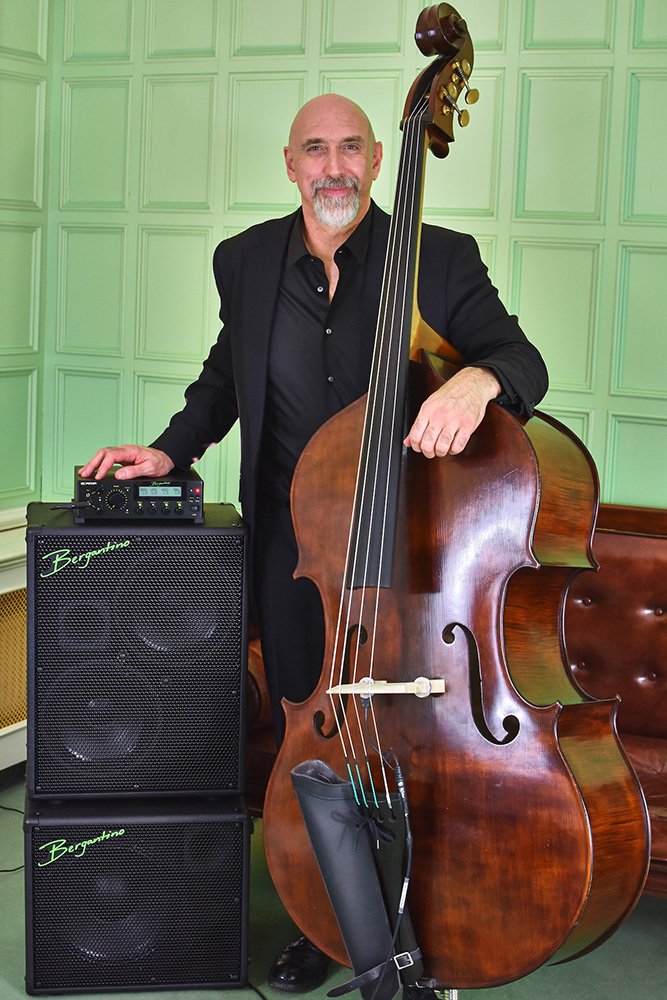
Since joining Jools Holland and His Rhythm and Blues Orchestra in 1991, Dave Swift has become one of the UK’s most prominent bassists. His multi-decade career includes performances with artists like George Benson, Eric Clapton, and Amy Winehouse. For a full list of collaborations, click here.
As a versatile musician, Swift has been the house bassist for TV shows like Don’t Forget Your Toothbrush and regularly performs on Later…with Jools Holland and the Jools Holland Show on BBC Radio 2. He has also played for Jools’ annual New Year’s Eve ‘Hootenanny’ TV show, which is broadcast by the BBC. His work extends to film, having recorded soundtracks for several British movies, including the recent period drama Me & Orson Welles.
This interview has been edited for clarity.
Dave’s Transcription Process
Jason: I found it fascinating to hear about your preparation process for performances with Jools, especially your approach to transcribing.
Dave: Sure. The thing is, I’m the only person in the rhythm section who reads music. There’s me and the horn section who read written notation, but the rest of them don’t. So when we get given anything to play with Jools on our TV or radio show, the rhythm section, we just get the recordings sent as an attachment in an email.
Jools will probably listen to the music while he’s driving along in his car. So Jools listens to it in a very casual, I guess more organic way, if you will. But the thing is that Jools knows I’m looking for detail.
The first thing I do is transcribe the original bass line note for note. Because if you’re playing with a very well-known, prestigious artist, more often than not, they want what’s on the recording because you’re playing one of their hits. Or you might be playing a new record off an album. So I think to myself, it’s important to have what’s there to begin with.
So yeah, I transcribe everything. Mistakes and all. I do the whole thing. And I don’t have any kind of software. I do it all, you know—I’ve got like a hundred 2B pencils, a whole box of erasers, and narrow manuscript paper.
I like that, too, because when I read it, it’s my own writing, my own notation. So, for me, it’s more recognizable.
Also, by transcribing, you get inside the music. If someone else gives you a transcription of anything, you have to question its accuracy—no disrespect to other people, but I’ve been given a lot of bad transcriptions.
When I do my own, I know it will be accurate. I spend a lot of time on it and have everything down note for note. When we turn up at the studio, whether it’s the TV or radio studio, I always inquire how accurate they want it to be. Do they want it as the original recording?
Some of them say yes, absolutely. So then I think, well, that’s great. Because I’ve already done the majority of the work. If they then say, “You can sort of fool around with it,” then that’s fine with me. I’ll happily improvise around it.
And if I haven’t done the transcription—in other words, I’ve just listened to it in a very casual manner—and then they turn around and say, “We want exactly what’s on the record,” then you’re in trouble. Because then you’ve got to go to another room, and you’ve got to start from scratch. You’ve got to listen to it all over again.
I’ll make every attempt to learn that by heart. And that’s just a case of repetition and just being at home and playing over and over again. But yeah, I’ve got folders and folders with thousands of transcriptions because every time I play with anyone on Jools’ show, if you look at my CV, all the lists of those names, I will have a transcription or more for each artist.
Jason: Did you start that transcription method right off from the beginning, playing with Jools, or was that something that evolved?
Dave: No, I did it with Jools because, here’s the thing with me, Jason. I was a classically trained trombonist; the trombone was my first instrument. So I learned music from reading it.
I didn’t learn to play by ear. You know, that took me a lot longer to get into. So, for me, at the beginning, everything was written down and whatnot. So when I got the Jools gig, I was still carrying that over, you know? I still wanted to have that accuracy of having things written down. But the great thing about the Jools gig is that it really helped me to free myself up from the written part because I realized there was a lot of stuff that we were going to be doing and that there was no time to do transcriptions.
Sometimes, we were playing by the seat of our pants. Jools’s radio show, for instance, has a BBC Radio 2 show that’s been going on for 17 years now. Most people don’t realize that he has a radio show. For the first 10 years, we knew who the guest was going to be, but we didn’t know what the song was going to be until they turned up.
Working with Amy Winehouse
So, a good example: Amy Winehouse was on the show once. She turned up at the studio, and we were all thrilled to be working with her. But the rhythm section was sitting there, thinking, “Well, what song is she going to do?” Because we hadn’t been told a thing.
She was sitting there filing her nails, and the manager put the CD of the album on in the background. We had to sit there in front of Amy Winehouse—we had two run-throughs. We listened to it twice, and then we had to record it live with her on the radio show. So I did that for ten years with Jools, so there I didn’t have the luxury of transcriptions.
But what it did do was run this through my ears. Because I was forced into that situation where it’s fight or flight, sink or swim, we had to do it. You know, my ears grew very quickly.
Jason: I can’t even imagine what that must have been like. The pressure of doing that is intense anyway, but to do it in front of someone like Amy Winehouse, with only two run-throughs—that’s incredible.
When you were first starting—I mean, obviously you did that for 10 years, and you developed some chops with that—were you writing things down when you were listening? Were you fingering through things on the bass? How on earth were you learning that song?
Dave: That’s a good question. Again, there was no time to write anything down, but I definitely had the bass on my lap.
We all had our instruments there, the rhythm section. And, you know, you’re just quietly tapping the notes. You know, without playing too loud, you’re just kind of mapping it out. And the truth is, Jason, I’ve been a professional musician for 35 years. I’ve been with Jools for 25 years.
So, 10 years before that, I was a freelance session musician. During that time, I had a lot of experience. I’ve played with many people, so a lot of it is down to that. It’s down to the fact that I’ve already played thousands and thousands of songs, and obviously, you start to recognize song forms. If you play enough songs, there are only so many variations.
So yeah, it’s down to experience. It’s just the amount of times I’ve had to play some of the tunes. There’s no other way to describe it other than you have to do it.
You just have to find a way, you know? You’ve got to pull out all the stops and use your memory and experience. Because there’s no—you can’t turn around after two run-throughs and say to someone like Amy Winehouse, “I’m sorry, darling. I still haven’t got it.”
Jason: That might be the end of the gig.
Dave: I think that’s something that I couldn’t have done when I was much younger. I was only able to do that after playing for like 20-odd years. This sort of thing—experience is a great thing.
Dave’s early years
Jason: Well, you know, what you’re most well known for is all this work with Jools’ band and all these people you’ve performed with. But I love your background—it’s just totally fascinating to me. It’s so unique, going from a trombonist to becoming a bass player.
Can you tell us about your introduction to music? When did your musical journey begin?
Dave: People often ask me, “Do you come from a musical family?” And the answer is yes and no because my parents listened to music. So, around the house, there was always music being played.
My dad had a couple of Peggy Lee albums. He loved opera for some reason. I don’t know why, because both my parents were very working class. They were factory workers, but there was always music in the house—Glenn Miller and things like that. And then I’ve got two older brothers who are eight and 11 years older than me.
And they did play; they both played acoustic guitar. So there were instruments in the house, and they were listening to things like Jimi Hendrix, Joni Mitchell, and Cream. I was a little kid stuck in the middle of all this. The first two films I saw at the cinema were “The Sound of Music” and “Paint Your Wagon.”
Jason: There we go.
Dave: So yeah, there was music in the air, and I discovered I had a good singing voice. In the early days, I was always picked to sing in the school choir. Then, when I was a little bit older, I sang in the church choir, and I was in the church choir for 10 years.
So, playing an instrument. I didn’t consider it because, as a kid, I was into horror movies. I love horror science fiction movies and wanted to be a horror movie makeup man. I was always making myself into monsters every day. So again, while I like music, I wasn’t thinking of it; anyway, at secondary school, after a few failed attempts at playing a few other things, I really fancied the idea of a trombone.
I was 14 when I went to the trombone teacher and said, “I’d like to have lessons.” He replied, “I can’t take you on.” When I asked why, he said, “You’re too old.”
Jason: Oh. Wow.
Dave: At 14 years of age. So, I pleaded with him. One of the main reasons was that he taught on a Thursday afternoon when I had double physics.
And I hated double physics. I couldn’t stand it. So, it was important for me to study with this guy because then I’d miss that lesson kind of thing. So yeah, he said okay, he took me on, and I took the trombone home with one of those “Tune a Day” books, one kind of beginner book. Something magical happened between me and the trombone.
We bonded instantly, and I absolutely loved it. I wasn’t a very good academic at school. I was overwhelmed by academia and very intimidated by it. So suddenly, I found something I really loved and wanted to practice, you know?
So yeah, when I got the trombone, I couldn’t put the thing down. I absolutely loved it. Six months later, the school band needed a bass guitar player. So I volunteered for whatever reason because I guess my brother was playing a bit of guitar. So I took up the bass guitar, and because I could only read music now, there was nothing that I couldn’t play on the bass guitar that I hadn’t already played on the trombone.
The trombone was a big, big help to me. Then my trombone teacher said, “Listen, you’re really good on both of these instruments, and I can probably get you some work when you leave school as a professional.”
But it’s just that he wanted all the trombone gigs for himself. He wasn’t going to recommend me for the trombone. But he knew bass players back then, where I’m originally from, were not many people who could read. There were a lot of bass owners and guys who could just busk, but guys who could read were few and far between.
So then he said to me, “You know, you should take up an acoustic bass, like the acoustic double bass.” He said, “Because if you do that, not many people double up and play both well. And if you do that, you’ll get a lot more work.” And that’s what happened. I’m self-taught as a bassist—firmly self-taught as a bass player.
I couldn’t believe that people were actually paying me money to play music. I never anticipated that. I never intended to be a professional musician. It all happened completely by accident.
Jason: It’s fascinating how often that happens to people. You mentioned there are many bass owners, but not necessarily bass players.
Dave: Oh, yeah. Particularly with upright players as well. There were a lot of guys, you know, and you couldn’t hear them on gigs. They’re thumping away in the background; basically, they could have been playing anything. But because they actually had a bass, they would get the gig. But I was far more conscientious than that. I didn’t want to do things by half. So, I really worked hard with all three instruments at the time, but, like I said, I was self-taught as a bass player. I had a couple of lessons early on with a couple of orchestral players just to get some technique together.
Jason: Sure.
Studying with Michael Moore
Dave: And much later on, I actually studied with Michael Moore.
Jason: Oh, I’m very familiar with him. He wrote a fascinating technique book that I’ve got. What was that experience like working with Michael? I’ve never met him personally, but I’ve heard so much about him. What was he like as a teacher?
Dave: Well, here’s the thing. This was much later. This was after I moved to London. This was like the early ’90s. And what happened is that I’ve always been very conscientious about studying.
I left school at 16, and I didn’t go to college. So, after that, I was determined to make up for all that lost time. Someone told me that he’d moved to London. He’d come over with his wife, I think, and they said he was looking to do some teaching. So they said, “You know, you should go along.” I knew him from a few recordings, and I always loved his beautiful melodic playing and great thumb technique, so I just thought, “Wow, I’ve got to do this.”
So yes, I studied with him for the best part of six months. I didn’t fully appreciate what he was showing me at the time. In other words, I asked him more about technique and fingerings and such. It wasn’t until afterward that I realized there was much more depth to what he had taught me.
And I looked back and thought, “Oh, there’s so much more in-depth stuff.” I was asking him very fundamental things, you know. I wanted help with my thumb position, and also, the one thing Michael did do was put me onto the German bow.
I’d been playing just a little bit with the French bow. I don’t use the bow very much, but I’d use the French bow. He’d been studying the Ludwig Streicher method and switched to the German bow. He said, “I much prefer it. I think you will, too.” So he gave me some arco lessons.
I was still in my 20s, and if I were studying with him now, or even when I was in my 30s or 40s, it would have been a very different experience because there would have been so many more in-depth things I would have asked him. So, I feel I should have asked him many more questions.
During our lessons, he played the piano and ran through some standards, and I played bass with him. He even gave me some rudimentary piano lessons. So I’d sit there, kind of plunking out some chords badly while he played the bass and soloed so I could hear what he was doing.
I wish that I had been a bit more conscientious. I could have asked him so much more, but it was still a great experience. He was just a wonderful guy. If I’m correct, I think his last gig was with Dave Brubeck.
Jason: Yeah, that’s fascinating. I remember picking up his book in college with an interesting approach to thumb position and mapping out on the bass.
Dave: He showed me that before he did the book. This is way before that. So, I’ve got notes he wrote while working on that book. He said the stuff he gave me in the lessons later became the main body of that book. So that was pretty cool.
Jason: That’s so cool. Yeah. That was one of those books that changed how I thought about the bass, especially the bass in a jazz context.
The Trombone’s Lasting Impact
So, if we go back to your earlier years, were you keeping the trombone active once you got into playing the electric and double bass?
Dave: You know what? I was because the trombone was a great thing for me. When I was playing, the trombone was in every band imaginable. So I was playing in orchestras, I was playing in big bands, I was playing in funk bands, in little horn sections, I was playing in brass bands.
With all those things, I had to read four different clefs. In brass bands, trombones are always written in treble clef for some bizarre reason, and as you know, orchestral stuff uses bass, alto, and tenor clefs. So, for me, the trombone was such a big help in transitioning to playing bass.
I was playing all three instruments, but then, quite quickly, the whole world of bass took over. I was getting much more work because virtually every band needs a bass player, but not every band needs a trombone player.
Jason: Very true.
Dave: So I was doing much more work as an electric and an upright bassist.
I was exhausted from trying to keep those three instruments up to a very high standard. I just couldn’t do it, especially when I started to tour. So the trombone went by the wayside, but I guess I kept it up for about four or five years into being a professional bass player.
But, funnily enough, I took it up again a few years ago, just for my amusement and for no one else’s. Getting back into it was tough because it was so much harder as an adult. When I took it up as a 14-year-old, it seemed to be a lot easier for me, but it was tough when I took it up all these years later.
What’s fun now is this interesting cross-pollination going on because, you know, what I learned on the trombone, I put onto the bass in the beginning, and now I’m doing it the other way around. I’m using all my knowledge from being a bass player all these years to put on the trombone. Whether or not I’m going to gig on it, I’m not sure yet. It’s for my amusement.
How Wind Instrument Experience Shaped Dave’s Bass Phrasing
Jason: It’s fascinating because after taking so many years off, it’s almost like approaching the instrument anew, right? Even though you played it in your youth. I imagine it must be intriguing to explore the unique aspects of the trombone, particularly how using your breath affects phrasing. That’s quite a different concept on a wind instrument compared to bass, isn’t it? It must be an interesting area to delve into.
Dave: Well, I think that’s why I was so keen to return to it. Because, I mean, bear in mind, Jason, predominantly, my upright playing is really 98% pizzicato, which is what I have to do. I just did a tour recently with Alexander Armstrong, a TV show host, but he sings too.
And on his last tour, his music was very orchestral. So the whole thing was arco the whole time, which I love doing. But other than that, virtually everything I do with Jools is either blues, big band, or pop. So yeah, I don’t use the bow that much.
And I miss playing something that you’re physically putting air through. The instrument just seemed a lot more personal to me. Now, I have been more of an orchestral player, where I play predominantly with a bow—where, you know, phrasing is much more important, and you can do a lot more with it.
It wouldn’t have been so bad, but I guess because I was mainly doing pit work, you know, I was missing an instrument that I could sustain notes on and put much more expression into. So yeah, that’s why I wanted to go back to revisit the trombone. And also, I was fascinated by—you know, same as with fretless bass guitar—the whole thing where there are no set positions.
Dave’s Passion for Jazz
Jason: I know that Jazz has been a passion for you your whole life, and early on, you worked as a jazz bassist before Jools’ band. Is that right?
Dave: Well, here’s the thing. I always aspired to be a full-time jazz musician, and everything I practiced reflected that. I remember the first time I went to New York on the QE2, the original Queen Elizabeth cruise ship.
I first went with a friend of mine, a renowned British jazz saxophonist called Julian Argüelles. We were in this kind of house band on the ship, and we remember we got to New York, and we couldn’t be more excited. We’d never been there before, and coming in on the QE2 as well—how cool was that?
We went to Manny’s and bought a couple of fake books. When we got back to the cruise ship, I brought a load of those Jamey Aebersold play-along things because that’s what I wanted to do.
I wanted to learn all those standards. So even though the stuff we were playing on the cruise ship wasn’t always what we wanted to be playing, in our own time, we’d always be sitting learning songs and I’d be transcribing Weather Report stuff. So even though I was playing more cabaret-type things at the time, my aspirations were always higher.
Any of my spare time was always spent practicing jazz techniques, whether I was transcribing Ray Brown basslines or solos or Jaco stuff. The trouble is, when I moved to London after 10 years of being a session guy—bearing in mind, I’m talking about having to play other people’s charts.
Notation. You know, quite some of it was quite strict, and I was desperate to play with more creative musicians playing creative music. And that’s why I moved to London. I wanted to go and study at Berklee, but at the time, in the eighties, it was so expensive. I couldn’t afford to go there.
So for me, the next best thing was moving to London. I did that at the end of the eighties. I didn’t play electric bass. I played exclusively upright bass. All I did was say to myself, “Okay, I knew I could have gone and done a West End show.”
I could have easily sat in on that. I could have done more sessions. And I said, “No, I’ve done all this before. This is old territory. Now I want to play jazz properly full-time.” So I just decided to play with those kinds of musicians. So I went to jam sessions, and, yeah, I played exclusively with jazz guys. And still, while I was at home, you know, listening to Bill Evans albums and transcribing Scott LaFaro and all that kind of stuff.
So, the trouble was, I got the Jools gig. And I had a real dilemma because while I was finally enjoying being a full-time jazz musician, I was suffering for my art. And by that, I mean suffering. You know, and then suddenly, the Jools crew came along. And there was an opportunity to play with, you know, quite a well-known, high-profile music industry figure.
So by two—and bear in mind, back then with Jools, he wasn’t the person he is now. He didn’t have the TV show that he had. He’d only just left Squeeze, the pop band he used to be in. So, he was just starting as a solo artist.
In fairness, he didn’t have a TV or a radio show. He wasn’t the guy that he is now. It was just a few gigs at the time, but I guess I thought, well, you know, maybe this could be good for my career, so I chose to go with Jools.
Now, admittedly, a lot of stuff that we do is jazz-oriented—big bands, blues stuff—but it’s not what you’d call hardcore jazz. You know, we’re not really playing bebop or anything like that. So that’s why, in between doing the Jools gig, I still try to do those gigs.
It’s much more commercial because I’m not doing much of that with Jools. The band now, you know, but jazz has always been the most important for me. If you look at my record collection, there’s loads of funk in there, there’s rock stuff, there’s pop, but 98% of it is jazz.
I listened to that, and I still practice it at home. I’m still transcribing all the time. Great bass players, solos, and that stuff. So that’s still my main motivation.
Transcribing the Greats
Jason: You were talking about how you transcribe for Jools band. Is that what you would do when transcribing like Jaco or Scott LaFaro?
Dave: Well, what I used to do is—probably not with a double bass because I’ve got a little tiny music room that’s not big enough to get a double bass in—so yeah, I have a bass guitar with me. And, you know, when I first started to do transcriptions… Do you know what?
I think I might be old enough, Jason, to remember lifting the needle off the record and going back over and over. I may be that old. But of course, you know, we use a cassette player a lot of the time. Then the revelation for me was getting one of the transcription devices—I think Tascam made it.
You could slow the CD down and that stuff, but later on, I upgraded to the software you can get. I think, what is it now? You get the Amazing Slow Downer and Transcribe! But, yeah, you’d see me in a room with a piece of manuscript paper and a pencil, just doing it by hand. I remember once I did a transcription of Jaco’s “Donna Lee” from the solo album, and I mean the whole thing.
Jason: Oh, wow.
Dave: And do you know what? It must have taken me six months. I wasn’t sitting in that chair doing anything else for six months. I was sleeping and eating. But you know, a lot of time, and it’s God knows how many pages long—eight pages long, whatever. Transcriptions, to me, I love doing them because I know a lot of younger players don’t like doing it because it’s a lot of work.
These days, there are so many transcription books you can buy, and people want to go and buy these books and have an easy life. But what I always say to them is, first of all, many books are quite inaccurate. I’ve seen some shocking transcription books over the years.
Apart from anything else, if you’re just reading someone else’s transcription, you’re not really getting into the heart of the song, the bass line, or the solo. It’s only when you start to transcribe it yourself that you really begin to absorb it into every pore of your body.
And that’s, to me, that’s how you learn. That’s how you really, really learn on a deeper level. So I’ve always done that. And I’ve always said that hard work is its own reward. It’s good for your ears. It’s good for your writing skills. Everything about transcription is wonderful, and I do it all the time.
It’s quite scary, though. When I look back at some of my early Jaco stuff, I remember I transcribed Black Market once, and I look at it now, and it’s so bad. There are like bars of seven and four and a half, three and seven eighths. You know, because I don’t know, I just, if for some reason when I was younger, my reading was better than my writing, my transcriptions, you know, but I’ve worked, I’ve worked hard a lot on that.
So now I’m pretty happy with that. And what I’ve got at home is several folders of all my favorite bass players, and each folder is jam-packed with transcriptions of theirs. So I’m a big, big fan of Anthony Jackson. He’s one of my favorite bass guitarists of all time. So I’ve got an Anthony Jackson pad. I’ve got a Jaco pad. I think I’ve got a Pino Palladino one, and I just spent, you know, Jimmy Blanton, Ray Brown, and all those guys. And you get into the heart and soul of those players when you scrutinize things like that. The only way to do that is through transcription.
Developing Ear Skills: A Journey into Aural Learning
Jason: Yeah, exactly. Buying a book misses the point entirely. It’s fascinating to me—you’re a really good reader, and I am, too. Talking to other strong readers who’ve transitioned to relying more on their ears, like you do now, it’s almost as if reading becomes a crutch. That ability to read well can actually limit your capacity to truly hear things. Was it in Jools’ band that you started getting comfortable learning things by ear?
Dave: Yeah, very much so. I mean, that’s a really good point.
When I first started as a trombone and bass player, I was fine if you put anything in front of me, whether it was a solo or bass part. But I’m talking about written notation here. And even further, when I started to play in big bands, I was fine with all the written charts.
And suddenly, I started to get all these other parts with it. I didn’t fully understand. I recognized really basic stuff, but when you started to see altered dominant chords and the more advanced harmony, I hadn’t got a clue because I’d never studied harmony. My music education was from the trombone, so I never played the piano.
I didn’t study a harmony instrument. So, all of a sudden, I’m getting these big band charts with chords everywhere. And I was—this was tough for me. Then I remember I played in one big band, and there were a couple of older guys in it. During each show, we had a whole pad of music, and I was fine with that. But during the show, they’d call out a small group and play just a standard with, you know, four of us.
And they called me out, and they called, I don’t know, it might have been “All the Things You Are,” and I’m looking at them kind of going, “What? How? What? How?” Now, if you’d have given me the part for it or even a chord sheet, I’d be fine, but I just didn’t know it because I’d never been in a situation where I had to play without charts.
That was the thing! Everything I did was music written down. So, when I got the Jools gig, you know, I realized quickly that I wasn’t gonna be given a written bass part for anything. That was for sure. At best, I may have been given a chord chart, but I realized most of it was this: I got given two plastic bags worth of cassette tapes of all Jools’s stuff.
I had to go home and learn it. Now, I admit it. First of all, I transcribed it all. Most of it was walking lines, but I got stuck in the old ways. I felt that if I were going to do a good job of this, I had to have it on the written page. But then I quickly realized how cumbersome this was.
The more gigs I did with Jools, the better my ears got. I realized I didn’t have to rely on this anymore. But it was a lengthy transition. It didn’t happen overnight.
And it took me a few years to level those two things up. And so now I’m really happy with both. Now it’s rare that I get asked to read. The main reading I do is of my own transcriptions because everything else, it’s all learned. For instance, when I did the jazz gig I was doing last night,
There are two clubs called the Boisdale Clubs in London. They have music every night, and the great thing is that there’s a house double bass at each one of them. There’s also a piano and a drum kit, so you don’t have to take your own gear.
Admittedly, the quality of the instrument and its setup can leave something to be desired, but just the fact that you turn up and you don’t have to bring your own gear is great. On those gigs, I don’t know—I know I will be playing with a piano player and a drummer, but I don’t necessarily know who they are or which ones will be there.
And I also don’t know what tunes are going to be called. So, I love that now. There was a time when I was younger, in my teens and early twenties, when that would have been my worst nightmare. Turning up, playing with someone you didn’t know, playing tunes that you’d never—I just couldn’t have done it, frankly.
It’s just taken me a while to make that transition. Yeah, it’s taken time, and I’ve been spending more time on ear training. I mean, that’s what I started to do. I bought a lot of ear training tapes—some of the David Baker stuff. I did that, and also, the big thing was that I studied privately with a few people, and I’m talking about harmony.
I studied with Michael Moore on the instrument itself, but I also studied with a few people who went to Berklee because I’d never studied harmony in my life. That opened everything up to me. So, I was playing for years before I studied the more academic side of it.
And this is an interesting point as well. Going back to Michael Moore, when I was studying with him, I said, “Improvisation has always been more of a challenge for me because of my background coming from a strict reading background.” So I said, “It’s taken me a lot longer to be able to play by ear and to be able to improvise confidently.”
And he told me this thing: he told me he was teaching at a Jamie Aebersold school once—a summer school—and had some free time, so he was wandering around sitting in on other tutors’ lessons. And I think someone was giving a lesson—I don’t know, they were harmonizing the melodic and harmonic minor scales.
Minor scales and coming up with all the modes for those. Michael Moore was in the back of the classroom and said, “I was watching this stuff, and I realized something.” He continued, “What they were teaching, I’ve been doing for years naturally. I’d been playing these modes, but I didn’t know what they were called, and I hadn’t studied them in any kind of academic way.”
But here he was, seeing these guys on the blackboard. And he said, “It’s so weird.” You know, he’d already been doing it because he’d just been listening to the recordings of people. He’d been transcribing stuff and playing along. And he said, “Thank goodness that I did it this way around.” He comes from a very organic, old-school way of learning to play by listening to other players.
Learning Music: Organic vs. Academic Approaches
Jason: That seems like the more organic way to do it rather than trying to fit.
Dave: Not to take it away from academia, though. I mean, I’m not saying that’s not part of it, but I guess I think the thing that I’ve noticed these days with young musicians is they put too much emphasis on the academic side of it. They think if they don’t study all this harmony and theory, they can’t even begin to improvise.
Until they’ve studied that stuff, they feel as though they’re not qualified, which isn’t the case. I mean, it’s the same as giving a newborn baby a dictionary and saying, “Don’t even think about forming a sentence until you’ve learned every word—every single word in this book and its meaning.”
Jason: That’s a great analogy.
I love that analogy. It’s so true—people often get paralyzed when it comes to improvisation. They think they need to know every single mode and every 2-5-1 progression before they can even start. It’s as if they don’t know where to begin. That’s why your point is so fantastic.
Dave: Yeah, I think people don’t listen enough. There are so many books on jazz improvisation now—you go into a store and there’s a shelf full of them. And I think people believe that if they take the book off the shelf and own that book, something magical is going to happen.
And you know what? I know guys who own those books and put them on their shelves. They never actually read them, but they look at the shelf and see “How to Improvise Jazz” and stuff. And they think just by owning it, there’s going to be some weird osmosis happening.
And the information is going to seep into their subconscious, you know? But I think, you know, that there may be too much emphasis on that study. So I think not enough people are listening enough, going back to the masters and just… Someone said to me once, he was a jazz guitarist, and he said, “Listen more than you play.”
Learning by Listening
And I think that he meant the trouble is that so many people at home now are just practicing like crazy, and they run out of time to actually sit and listen to an Oscar Peterson album or a Charlie Haden album or something like that. They’re so focused because they think, “Oh, I’ve got to do this amount of practice today.”
“I haven’t done these scales. I haven’t done technique.” They go a whole day without listening to a piece of music. And I think that’s what this jazz guitarist meant because he was from a more old school approach, you know? He learned purely by ear—I don’t think he studied harmony in his life.
He just learned from listening to all the great guitar players.
Jason: Yeah, that’s an interesting point. It seems like the people who would actually go to concerts, see concerts, and listen to great recordings.
They end up being the people who, 10 or 20 years later, are doing the more significant things compared to those who had all the chops and stayed in the practice room on Friday nights woodshedding.
Dave: Well, interestingly, some of my favorite players are guys who didn’t go to music college or study.
A good example of this is Anthony Jackson. For me, he is just one of the most phenomenal electric bass players of all time and the inventor of the modern-day six-string bass. He’s an incredible musician, but I know Anthony wanted to go to Berklee back in the day, and back then, you couldn’t go if you were an electric bass player.
They wouldn’t take you on. I think you had to play upright, so he didn’t go. As far as I know, he didn’t go to college. He probably certainly studied with a few guys privately. I know he studied with Pat Martino, but Anthony’s mostly self-taught. He’s probably my favorite living bass guitarist, way more than a lot of the guys that went to loads of colleges and did degrees. And again, I’m not taking away from them. They’re still phenomenal players. Do they impress me? Sure. Do they move me? Maybe not so much.
And that’s the thing with me with music, Jason. I want to be moved more than I want to be impressed, is what I’m saying. that’s the key thing for me.
Dave’s Bass Evolution in Jools’ Band
Jason: You mentioned getting into Jools’s band and being told you were playing too much. How did that experience change your bass playing from when you started with the band to a couple of years later?
Dave: Well, it was quite radical because prior to being with Jools, in most of the things I did, I was always told off for overplaying. I guess the reason is that I was studying Jaco, Anthony, and these guys. I probably wasn’t paying enough attention to their good taste, which, of course, they had plenty of, but, you know, when you’re younger, you want to impress people, and you want to be noticed.
But yeah, when I got the Jools gig, first of all, you know, he wanted me more because I played upright, and a couple of the bass players he had before me didn’t play upright. So that was a big part of it, but he wasn’t interested in me playing bass guitar.
He wanted me to stick with that. But then, you know, we started to do a lot more TV where we played very commercial music. And the turning point was when we played with Chaka Khan on a TV show. She wanted to do a couple of hits, “Ain’t Nobody” and “I’m Every Woman.” I told Jools, “These are going to be hard work on string bass.”
I said, “Let me play the bass guitar.” He didn’t want me to because he loved the sound of the acoustic.
I assured him that wasn’t the case, and eventually, he let me play electric. But in the early days, he kept telling me to play less. And I think a lot of it is fundamentally related to Jools being a pianist, and particularly a boogie-woogie pianist. There’s a lot of stuff going on in his left hand.
He’s playing a lot of bass lines himself. So the two things he said to me were, apart from playing a whole lot less, he asked me to avoid playing in the lower registers of my instrument. So he wanted me to play, you know, in the middle and upper registers. And I think that was to keep out of his way.
But secondly, you know, a lot of the old recordings that Jools heard—if you were a double bass player back in the ’30s and the ’40s, the only way you could get heard in many of those recordings was to play higher up on the G and D strings. I mean, not necessarily soloing, but, you know, high-walking bass lines.
So Jools liked that too. So he asked me to play higher up. That was the first thing. And then, yeah, he definitely said, “Could you play a whole load less?” I remember once we did one gig, and I think I had some friends in the audience, and I was trying to show off a little bit. So there was one song where I did something that I wouldn’t normally do and put a few extra things in there.
And Jools came to me after the gig and he said, “Dave, you know, it was getting a little Weather Report back there.” I didn’t say anything, but I thought to myself—I actually said to myself, “I should be so lucky, and you should be so lucky, you know, if only.”
But here’s the other thing as well: he likes that kind of muted bass sound, you know when you get the bass guitar and your palm muted—I think it’s called palm muting.
Jason: Mm hmm.
Dave: So, in other words, he loves James Jamerson. Two of Jools’s favorite bass players are Charlie Mingus and James Jamerson. They’re two of my favorites. But Jamerson had that quite muted sound. He had the foam. So I didn’t want to do that because I just thought, well, if I put the foam in there, it will sound like that all night for every single song.
When you play with Jools, because we have to play with so many artists across different genres, that muted sound isn’t suit everything. So I just started to use that palm mute technique, and I played with my thumb. I was plucking with my thumb, like Monk Montgomery. If you look at his playing, I think that’s how he did it when he switched from upright to electric.
He was plucking with his thumb. So Jools encouraged that massively, but I think one of the reasons why he did it was he thought to himself, “When Dave’s just playing with his thumb, he’s not going to be able to play anywhere near as fast as he was playing with his two fingers.” So, it was interesting because first of all, it was frustrating, but it was a revelation because it changed my playing. It did make me a lot more thoughtful.
I thought I couldn’t play with the same speed and dexterity. But then it made me think—it made me feel much more about note choices, phrasing, and dynamics. So actually, you know, his kind of sneaky little plan to get me to play a lot fewer notes really made my playing much better.
It made me take a huge leap forward in my playing. So, yeah, it was funny, but then I had an injury. I had a very bad injury on my right-hand thumb. I snapped a ligament in my thumb a few years back. Yeah, it was pretty painful. And I was really panicking because I thought to myself, “Well, again, I’m a player that plays with my thumb, you know, not slap bass, but just plucking with it.”
So that was going to be a problem. And of course, playing German bow as well was going to cause me to have a problem. So I went to a specialist, and they talked about surgery. It would be really expensive if I went privately. In the end, I spoke to a few people who’d had the same surgery, and they told me not to do it because they had it themselves.
They said it didn’t go well; it wasn’t very successful. They had problems afterward, and they said, “You know what? If only you’d just let Mother Nature handle it.” And that’s exactly what happened. I went back to playing with my fingers, and actually, I started to play with a pick on the bass because that’s how I started when I first began.
So I was always a fan of people like Carol Kaye and players like that. These days, I actually play bass guitar with a pick about 95 percent of the time because some of my favorite players—pick players like Anthony Jackson, Steve Swallow, and Cody Wright—play with a pick.
A Glimpse into the Jools Holland Band’s Schedule
Jason: What does a typical week look like for you these days if there is such a thing?
Dave: Yeah, well, it all depends on whether the TV shows are returning. So when we start the tour, which is at the end of this month, we’re kind of out four or five days a week. You know, which leaves little time to do anything else.
But then, you know, if you’re touring and the TV shows are on, that’s tough, because the TV shows are recorded, say, on a Tuesday, and then we’ll go out on tour from Wednesday to Sunday. They called me an industrial bass player. And at first, I wasn’t quite sure how to take that.
You know, because most of the time, I used to be called melodic, inventive, whatever. But someone said, “You’re an industrial player.” And I kind of, after a while, understood it because it’s like being on a conveyor belt with Jools, you know? There was so much when we do his radio shows—again, they’re not on every week. You know, there are two TV shows each year; the radio shows are two series.
They try to keep those separate because I think if we were trying to do it all simultaneously, we would be out seven days a week, and we wouldn’t be able to sleep or do any laundry or anything like that. So that’s basically what they do—they separate the TV and radio shows. So, in some ways, to answer your question quickly, there isn’t a typical week.
Staying Healthy as a Musician
Dave: So now I’m more conscientious about health, and over the years, I’ve had some health issues. I lost a kidney back in the mid-nineties. It wasn’t due to anything I was doing to myself. It was just Mother Nature.
Something happened, and I was in the hospital for quite a while. My eating habits have changed. I eat a lot more healthily. I don’t drink as much alcohol. I certainly don’t drink before a gig or during a gig; I’ll wait till afterward.
But yeah, I just get more sleep—way more sleep. It’s also made me more conscientious about playing. In other words, I go back to my room, and sometimes, I still want to do a transcription. I’ll still do a little bit of practice, which, to me, is a lot more productive than being in the bar downstairs.
Yeah, it’s just that as you get older, you become more conscientious about it. I mean, I certainly have. You know, better diet, more sleep, and again, it means that I’m not waking up the next day with a hangover, and it means I can do some practice, I can do a transcription, you know, so I’m being more productive as well as healthier.
Sure, the rock and roll lifestyle has moderated to an extent. I’ve been doing it for 40-odd years. I think to myself, “Do I really want to keep doing this for another 20 years?” I thought, no, let’s look after myself a bit more because, you know, I still love doing what I’m doing, and I want a long career in this business.
Details from Dave in 2024
This interview will be published in Bass World, the International Society of Bassists’ magazine, in 2025. At that point Dave will have been a professional musician 44 years and have been Jools’ full time bass for 34 years.
Dave also passed along a few additional details (plus some great photos!) about his early years playing brass instruments and how he continues to do so with Jools’s band. He also shared some details and photos about a project with Rod Stewart that came out in 2024.
I actually started off playing euphonium at secondary school, but it was trombone I finally settled on. I did play some tuba at the same time, and in fact, these days, I play tuba way more than I play trombone. I think its because the tuba is more of a bass instrument, and let’s face it, the tuba and sousaphone were the original “bass instruments” in early jazz bands before being replaced with the “string bass”, so I definitely want to let people know about my passion for the tuba as much as I have for the double bass. I love playing my XO CC tuba these days, and I hope to add a sousaphone and bass trombone to my working arsenal very soon.

I’d definitely like to reiterate how useful it was playing trombone before I took up fretless bass guitar and double bass because obviously the lack of any note indicators meant that with all these instruments, ear training and muscle memory were key factors in playing these successfully and in tune.

Another point of potential interest. On Jools’ BBC Radio 2 show, I am the house bassist backing all the guest artists who are usually singers or singer/instrumentalists who play guitar or piano, but on several occasions, the guests have been bassists, including Jack Bruce, Mike Rutherford, Tony Visconti, and even Suzi Quatro! On these occasions, the artists (not wanting me to be left out) have requested me to play trombone or tuba with them, which I’ve happily done.
Rod Stewart Project Released in 2024

Jools and the band recorded an album with Rod Stewart called ‘Swing Fever’ which was released this year in February 2024 and it went to number 1 in the UK album charts, and of course I’m playing double bass on each track.

Dave’s Relationship with Barrie Kolstein
A big thanks to Barrie Kolstein for the idea to put together this feature on Dave. Dave shares a bit on how he got to know Barrie.
That all began around 2004 when I contacted him regarding an imminent trip to New York that year to attend the ‘Bass Player Live’ event, particularly to see Anthony Jackson presented with his Lifetime Achievement Award.

I knew about Barrie and the shop and Scott LaFaro’s restored Prescott bass. Being the fan of Scott that I was and still am, I arranged to visit Barrie at the shop immediately after I’d landed in New York to meet him and finally play the restored Prescott, which Barrie had kindly invited me to do.


