

Monkey Wrench Database: The Sheet Music Tool You Need to Know About
This is Monkey Wrench Database, created by Isaac Trapkus — a bassist in the New York Philharmonic and a true Renaissance person with many irons in the fire. In addition to playing with the Philharmonic, he created a super cool rosin called Winter Bassment Rosin —and now Summer Bassment, which I’m actually using right now.
It got hot here in San Francisco, and I did a whole video about that, which I’ll link up to. But as we were chatting about the rosin, Isaac dropped the word about this Monkey Wrench Database, and it is something else!
What Is It?
A little after 2022, Isaac found an amazing open-source tool a guy built—basically a way to take sheet music and a YouTube video and synchronize the measures. And not like a MuseScore or Finale sheet music file — the kind we’re always used to using. This tool takes a PDF and scans through it looking for staff lines and bar lines. When it finds those, it splits them up — with varying success — and then you go through manually and press a little key while the YouTube video plays, which maps timestamps to the measures.
Oh my goodness, everybody I’ve shown this to is blown away!
How to Get Started
Right now, this works better on desktop than on the phone, though I haven’t tried it on the phone recently, and this is evolving quickly. You can log in using a Gmail account, which will save what you’ve favorited and what you’re working on — but you don’t have to log in to use it. Right now there are 275 pieces in the database, and more are being added every day.
What It Can Do
You can pick your instrument — I’ll pick double bass — and then pick your recording. Press play and you’re following along in the sheet music with the video. You can go full screen. You can slow down or speed up in a pinch, though you’ll get some audio artifacting as you slow down, which is normal.
What’s really cool is that you can change the part on the fly while the recording is playing. Jump from the bass part to the full score, switch to two pages, check out the clarinet part — it’s all right there. And the sheet music is now an interactive thing, so you can click anywhere and it jumps to that point in the music. Want to practice starting at rehearsal number nine? Just click it and you’re there.
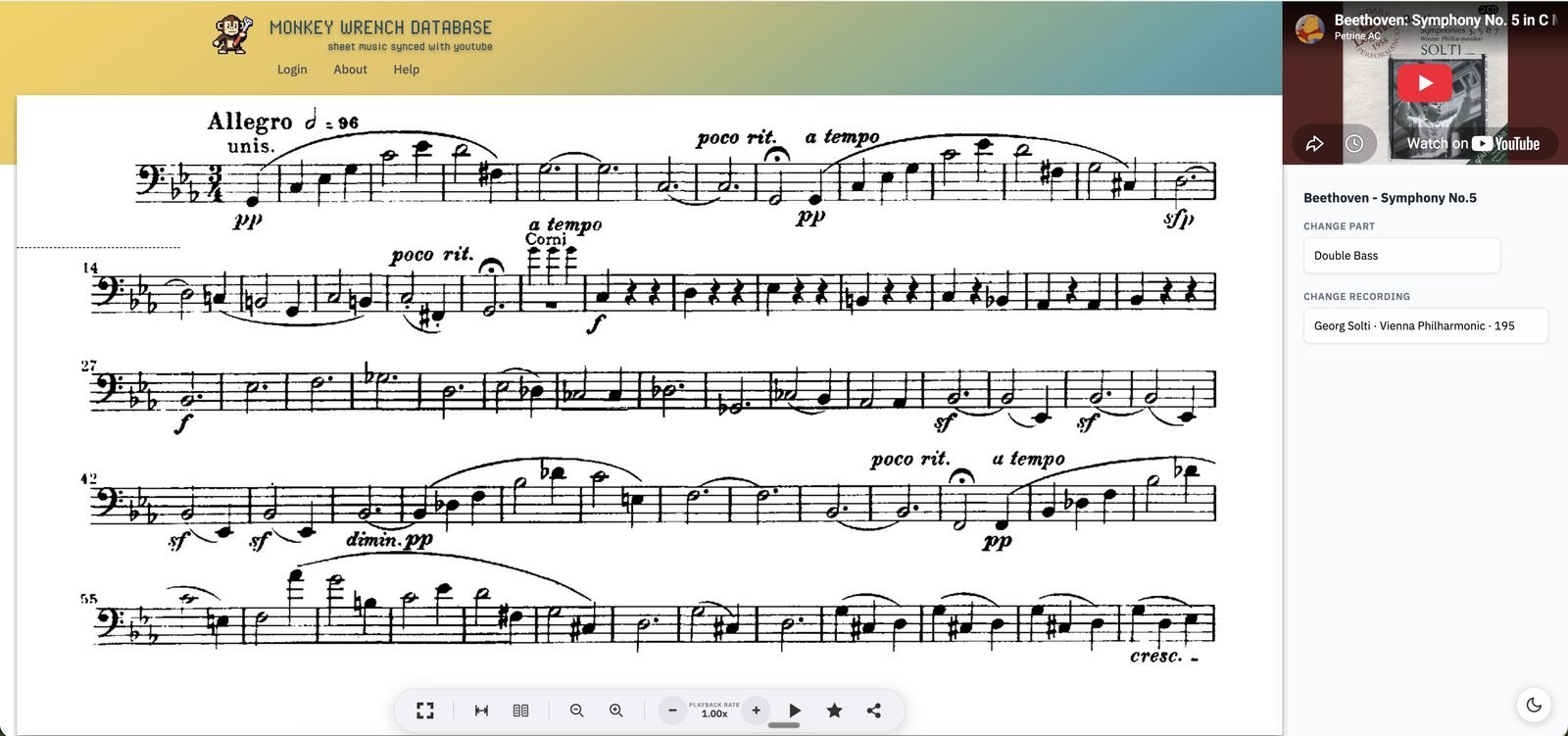
You can also switch recordings on the fly, and it preserves your measure position. So if you want to compare how Zelenka sounds versus Carillon or Concertina or any other recording, you just switch — and you’re looking at the same measure in a completely different performance. The difference in tempo and interpretation across recordings is remarkable to hear side by side.
You can also go back to your history to see what you’ve worked on recently, or pull up your favorites list.
The Origins of Monkey Wrench
The original open-source tool was built by someone named Wimbry — I believe he’s a retired professor from Denmark who just enjoys doing fancy engineering and computer work, and music notation was a side fascination. The critical thing is that he made it open source. Had he not done that, nobody could have taken it and run with it.
Isaac found it and saw the potential. It was written in JavaScript, which he knew, but at some point he hit a wall in what he could do with his existing skills. By 2023 and 2024, AI tools helped push it further, and now you can switch parts, switch recordings, preserve your measure position, and navigate the library the way you can today.
Building the Library
This is like a library that has to be built piece by piece, and Isaac is working on how much of that process can be automated — though those are big, complicated challenges, and some of it will still need a lot of human help. This isn’t a viable commercial business in the traditional sense.
Nobody is going to pay people to do enormous amounts of this work— it will require volunteer contributions, much like IMSLP needed a community of people to build it into what it is today. Isaac himself has spent an incalculable number of hours getting it to where it is now.
The project started as a double bass project since Isaac is a double bassist, but as you can see, it has expanded significantly. String parts are built out for many pieces, and something like Beethoven is more fully developed than others. It’s all under heavy construction, and the potential here is enormous.
Get Involved
If you’d like to volunteer to help build this out and help it scale, you can email Isaac directly — the address is right there on the site. Definitely check it out, and if you enjoyed this more technical video and tools like this, check out what we’ve got linked up here.
We discuss topics like this every week in our email newsletter. We also offer free monthly sheet music giveaways, community news, and all sorts of cool opportunities for bass players. If you’re not on the list, consider subscribing!


